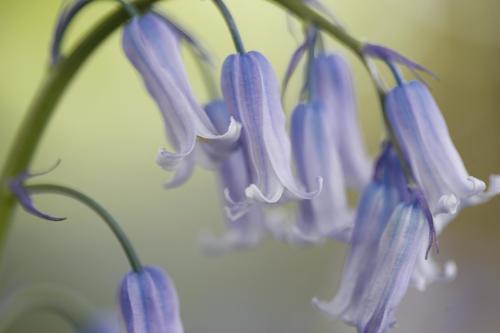
bluebell
Hyacinthoides non-scripta
Step into a fairy-tale landscape. The English bluebell is the crown jewel of the spring woodland, famous for its nodding violet bells and intoxicating scent.
Quick Identification
Size
Height 20–50 cm (8–20 inches); flower length 1.5–2 cm (0.6–0.8 inches)
Colors
Deep violet-blue petals; cream-white pollen; narrow green basal leaves
Key Features
- Nodding flower spike that droops distinctly to one side
- Tubular, bell-shaped flowers with petals curled back at the tips
- Intensely sweet, floral fragrance
- Flowers arranged in a single row along the stem
When You’ll See Them
Geographic range
Where Does the bluebell Live?
Native to the Atlantic regions of Western Europe, the common bluebell is most famously associated with the British Isles, which hold nearly half of the world's population. Its native range extends from the northwestern Iberian Peninsula through France and Belgium to the United Kingdom and Ireland. While it has been introduced as a garden plant in North America and parts of Central Europe, it thrives best in the mild, humid climates of the Atlantic fringe.
Basemap © OpenStreetMap contributors
Behavior
The common bluebell is a 'spring ephemeral,' a plant that spends most of the year as a dormant bulb underground. It emerges in early spring, rushing to flower and produce seeds before the trees above it grow their full leaves and block the sunlight. This synchronized blooming creates the famous 'blue carpet' effect in ancient woodlands, a strategy that helps attract a high volume of early-season pollinators.
Bluebells are highly social plants, often forming dense colonies that exclude other species. They interact with wildlife by providing a vital early nectar source for bees, butterflies, and hoverflies. While they appear hardy, they are quite fragile; their leaves are easily damaged by foot traffic, which prevents the bulb from storing enough energy to bloom the following year.
EverydayEarth exclusive
Camera Tips
Capturing the perfect bluebell photo with a backyard or trail camera requires a focus on time-lapse and macro settings. Since these plants are stationary, the most rewarding project is a 'bloom-lapse.' Set your camera to take one high-resolution photo every 2-4 hours starting in late March. By the time May arrives, you’ll have a stunning visual record of the bells emerging and the forest floor transforming from brown to blue.
For placement, avoid the standard eye-level tree mount. Instead, use a ground stake or a flexible mini-tripod to position the camera just 10-15 cm (4-6 inches) off the ground. Angle the lens slightly upward to look into the 'bells' of the flowers. This 'bug’s eye view' creates a more immersive and majestic feel than a top-down shot. If your camera has a macro lens or adjustable focus, set it for about 1 meter to capture sharp details of the recurved petals.
Pay close attention to lighting. Direct midday sun can wash out the delicate blue-violet hues, making them look grey. The best colors are captured during the 'golden hour' or on slightly overcast days when the light is diffused. If you are using an AI-powered camera that triggers on motion, it will likely be set off by the wind; use this to your advantage to capture 'video portraits' of the nodding stems, or look for pollinator activity like bumblebees visiting the flowers.
Similar Species
Species that look similar or are commonly confused with bluebell.
Frequently Asked Questions
Record bluebell at your habitat
Connect a camera to start building your own species record — AI identifies every visitor automatically.