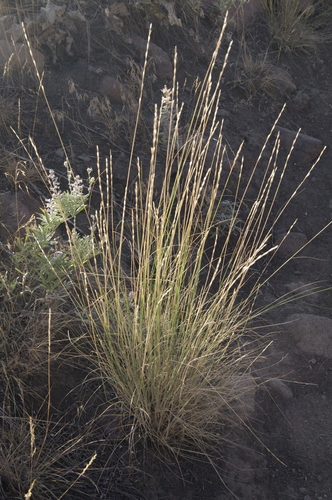
Bluebunch Wheatgrass
Pseudoroegneria spicata
The iconic bunchgrass of the American West, known for its striking blue-green color and its role as a vital lifeline for wintering wildlife.
Quick Identification
Size
Height of 60-100 cm (24-40 inches); bunch diameter of 15-30 cm (6-12 inches)
Colors
Distinctive blue-green or glaucous foliage; dries to a golden-straw color in late summer
Key Features
- Erect, bunched growth habit without rhizomes
- Divergent awns on seeds that bend outward at nearly 90 degrees
- Waxy, blue-green leaf blades often rolled inward
- Slender seed spikes 8-15 cm long
When You’ll See Them
Geographic range
Where Does the Bluebunch Wheatgrass Live?
Bluebunch Wheatgrass is a quintessential inhabitant of the Western North American landscape. Its vast range extends from the subarctic reaches of Alaska and the Yukon Territory, stretching southward through the interior of British Columbia and the Pacific Northwest. It is most dominant across the Great Basin and the Rocky Mountain states, reaching as far south as the northern highlands of Mexico, thriving in areas where winters are cold and summers are dry.
Basemap © OpenStreetMap contributors
Behavior
Bluebunch Wheatgrass is a long-lived perennial bunchgrass that serves as the cornerstone of the sagebrush-steppe ecosystem. Unlike sod-forming grasses, it grows in discrete, tidy clumps, leaving space for wildflowers and biological soil crusts to thrive between individuals. It is remarkably drought-tolerant, entering a dormant state during the hottest, driest parts of the summer to conserve moisture.
As a key foundational species, its 'behavior' in the ecosystem is one of support and resilience. It provides critical early-season forage for wildlife and stabilizes arid soils with a deep, fibrous root system that can reach depths of nearly two meters. It is fire-adapted, often resprouting from its crown after a fast-moving wildfire, provided the burn isn't too intense.
EverydayEarth exclusive
Camera Tips
Capturing Bluebunch Wheatgrass on a trail camera is a unique challenge because its movement in the wind can often lead to hundreds of 'false trigger' photos. To get the best results, place your camera on a sturdy stake or post about 24 inches off the ground. If you are using AI-powered cameras, set your sensitivity to medium to avoid the grass itself triggering the shutter, but use the grass as a 'natural lure' for the animals that eat it, such as Mule Deer or Elk.
For beautiful botanical shots, position your camera to face East or West to capture the 'golden hour' light filtering through the seed heads. The divergent awns (the tiny bristles on the seeds) create a stunning silhouette against low-angle sunlight. If your camera has a macro or close-focus setting, try to frame a single bunch against a dark background, like a distant canyon wall, to highlight its blue-green hue.
In the winter, this grass stays standing even under light snow, providing a great vertical element for your photos. Look for tracks leading toward the bunches; since this is a primary winter food source, cameras placed near healthy stands of Bluebunch Wheatgrass are much more likely to capture large ungulates and foraging birds like Meadowlarks during the colder months. Adjust your camera to take short video bursts (5-10 seconds) to capture the graceful swaying motion that defines the Western prairie.
Similar Species
Species that look similar or are commonly confused with Bluebunch Wheatgrass.
Crested Wheatgrass
Features a much wider, flattened, comb-like seed head and lacks the blue-green waxy color.
Idaho Fescue
Has much finer, hair-like leaves and smaller, more delicate seed heads compared to the robust wheatgrass spikes.
Western Wheatgrass
A sod-forming grass with underground rhizomes rather than a bunchgrass; its leaves have much more prominent ridges on the top side.
Frequently Asked Questions
Record Bluebunch Wheatgrass at your habitat
Connect a camera to start building your own species record — AI identifies every visitor automatically.