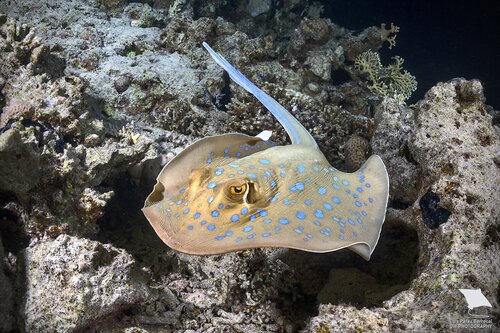
Bluespotted Fantail Ray
Taeniura lymma
Admired for its stunning electric blue spots and graceful underwater movement, the Bluespotted Fantail Ray is a vibrant icon of the Indo-Pacific's coral reefs. This small stingray is a master of the seafloor, navigating the intersection of sand and coral with ease.
Quick Identification
Size
Pectoral fin disc width up to 35 cm (14 in); total length including tail up to 80 cm (31 in)
Colors
Dorsal surface is yellowish-brown to tan with numerous bright electric blue spots; the tail features two distinct blue longitudinal stripes.
Key Features
- Oval-shaped pectoral fin disc
- Vibrant electric blue spots on a golden background
- Large, protruding golden-yellow eyes
- Short, thick tail with two blue stripes and a deep fin fold underneath
When You’ll See Them
Geographic range
Where Does the Bluespotted Fantail Ray Live?
The Bluespotted Fantail Ray is a quintessential inhabitant of the tropical Indo-Pacific region, with a massive range extending from the Red Sea and the eastern coast of Africa across to the Solomon Islands. This species is commonly found in the warm, nearshore waters of Indonesia, the Philippines, and Thailand, and is a frequent sight throughout the Great Barrier Reef in Australia. Its distribution also reaches as far north as the Ryukyu Islands of Japan and southward to the northern coast of New South Wales.
Basemap © OpenStreetMap contributors
Behavior
The Bluespotted Fantail Ray is a shy and predominantly solitary species that spends much of its daylight hours hiding. It is frequently found resting under coral ledges, tucked into crevices, or occasionally partially buried in the sand near reef structures. Unlike some other ray species, it rarely covers itself completely, perhaps because its bright coloration serves as a warning to potential predators.
As the tide begins to rise, these rays become more active and venture out from the reef onto shallow sand flats and seagrass beds. They are specialized foragers, using their pectoral fins to disturb the substrate and uncover buried prey. While they generally avoid human interaction and will swim away if disturbed, they are equipped with venomous stings on their tail for defense and should be treated with caution by swimmers and divers.
EverydayEarth exclusive
Camera Tips
To capture high-quality footage of a Bluespotted Fantail Ray, you will need a waterproof AI camera setup capable of operating in a marine environment. Since these rays are strictly bottom-dwellers, the most effective placement is on the sandy floor at the edge of a coral reef or near a pier piling. Use a weighted base or a low-profile weighted tripod to ensure the camera remains steady against tidal currents and surge. Position the lens horizontally, approximately 10 to 15 centimeters above the sand, facing a clearing where you have noticed 'feeding pits'—small circular depressions in the substrate.
Because these rays move into the shallows with the tide, your best results will come from syncing your camera's activity with the local tide chart. Set your camera to record during the two hours surrounding high tide, especially if those times coincide with dawn or dusk. The natural crepuscular activity of the species combined with the high water level provides the best opportunity to see them foraging close to shore. If your property is on a lagoon or canal, focus on areas with minimal boat traffic, as these rays are easily spooked by engine noise.
Lighting is the biggest challenge for identifying the Bluespotted Fantail Ray on camera. In shallow water, natural light is often enough, but in deeper areas or during low-light hours, the electric blue spots can lose their vibrance. Using a wide-angle underwater video light with a high color rendering index (CRI) will help the AI distinguish the ray from the mottled reef background. Adjust your camera's motion sensitivity to a high level to ensure the undulating movement of the ray’s fins triggers the recording, but be prepared to filter out clips of swaying seagrass or floating kelp. Avoid using bait, which can attract larger predators like sharks that might damage your equipment; the ray's natural curiosity and movement patterns are usually sufficient for a great shot.
Frequently Asked Questions
Record Bluespotted Fantail Ray at your habitat
Connect a camera to start building your own species record — AI identifies every visitor automatically.