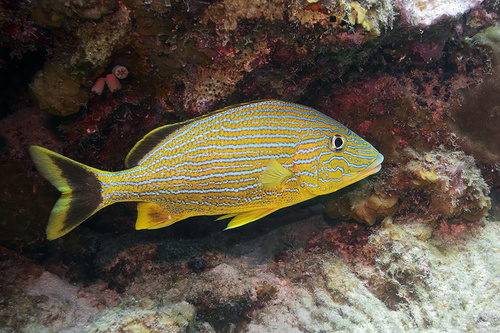
Bluestriped Grunt
Haemulon sciurus
With its brilliant gold body and electric blue racing stripes, the Bluestriped Grunt is the colorful soul of the Atlantic reef. Whether they are schooling by day or hunting by night, these vocal 'grunters' are a captivating sight for any underwater camera enthusiast.
Quick Identification
Size
Typically 20-30 cm (8-12 inches) in length, with a maximum recorded length of 46 cm (18 inches) and weight around 0.7-1 kg (1.5-2.2 lbs).
Colors
Bright yellow to golden-yellow body covered with numerous narrow, horizontal neon-blue stripes. The tail and the rear part of the dorsal fin are noticeably dark or blackish, and the inside of the mouth is a vivid red or orange.
Key Features
- Horizontal blue stripes over a yellow body
- Dark or blackish tail and soft dorsal fin
- Bright red-orange interior of the mouth
- Deeply notched dorsal fin
- Schooling behavior near reef structures
When You’ll See Them
Geographic range
Where Does the Bluestriped Grunt Live?
The Bluestriped Grunt is a signature species of the Western Atlantic's warm coastal waters. Its native range extends from the shores of South Carolina and the Florida Keys, stretching across the Gulf of Mexico and throughout the entire Caribbean Sea. This vibrant fish is a common sight as far south as the coast of Brazil, making it one of the most widely distributed and recognizable reef fish in the tropical Atlantic region.
Basemap © OpenStreetMap contributors
Behavior
The Bluestriped Grunt is a highly social species, known for forming large, dense schools during the daylight hours. These schools often congregate under coral overhangs, near reef ledges, or within the protective roots of mangroves. They are famous for the 'grunting' sound that gives them their name, produced by grinding their pharyngeal teeth together and amplifying the sound with their swim bladder, a behavior often observed when the fish is stressed or competing for space.
While they are relatively stationary and visible to divers during the day, their behavior shifts dramatically at night. As the sun sets, the schools disperse as individuals head into nearby seagrass beds and sandy flats to forage. They are generally peaceful but can be territorial over specific hiding spots within the reef. To humans, they are curious but cautious, often allowing close approach if the observer moves slowly.
EverydayEarth exclusive
Camera Tips
Capturing the Bluestriped Grunt requires a waterproof action camera or a dedicated underwater housing for your trail cam. For the best results, mount your camera at a depth of 5 to 15 feet near 'cleaning stations' or large coral heads where these fish naturally congregate during the day. Use a weighted tripod or a secure strap mount attached to a non-living reef structure or a pier piling. Because their scales are highly reflective, position the camera so the sun is behind it to avoid blowing out the vibrant yellow and blue details.
To capture their unique nocturnal foraging, use a camera with high-quality low-light sensors or an infrared flash. Since Bluestriped Grunts disperse into seagrass beds at night, placing a camera at the interface between a reef and a sandy flat is an excellent strategy for catching them in motion. If you are using a camera with audio capabilities, place it very close to a known schooling spot; you may be lucky enough to record the distinct 'grunting' sounds they make when interacting with each other.
For the most cinematic footage, set your camera to a high frame rate (60fps or higher). These fish often perform sudden, synchronized turns when schooling, and slow-motion playback reveals the incredible coordination of the group. Avoid using bright white LED lights at night, as this can spook the fish or attract unwanted swarms of tiny planktonic organisms that will cloud the lens. Instead, a red-light filter or low-intensity warm light is preferred for natural behavior.
Similar Species
Species that look similar or are commonly confused with Bluestriped Grunt.
French Grunt
Has diagonal yellow stripes below the lateral line, whereas the Bluestriped Grunt's stripes are all horizontal.
White Grunt
Lacks the bold yellow body color, appearing more silvery-white with blue stripes only on the head.
Smallmouth Grunt
Much smaller and more slender with a distinctively small mouth and more muted coloration.
Frequently Asked Questions
Record Bluestriped Grunt at your habitat
Connect a camera to start building your own species record — AI identifies every visitor automatically.