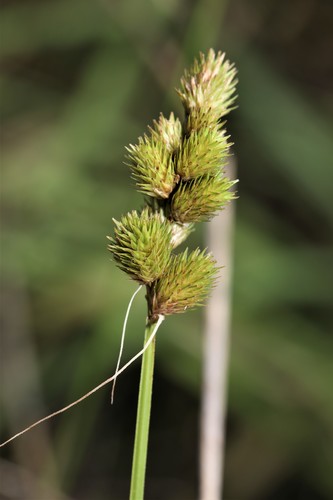
blunt broom sedge
Carex tribuloides
A vital wetland anchor, the blunt broom sedge is more than just a grass-like plant—it's a critical pit stop for migratory birds and a hallmark of healthy eastern floodplains.
Quick Identification
Size
Stems typically reach 60 to 100 cm (2 to 3.3 ft) in height; leaves are 3 to 8 mm (0.12 to 0.31 in) wide.
Colors
Bright green to yellowish-green foliage with pale green flower spikes that turn tan or straw-colored as they mature.
Key Features
- Clump-forming growth habit with winged stems
- Cluster of 6-15 overlapping, egg-shaped flower spikes
- Blunt-tipped floral scales rather than pointed ones
- Loose, thin leaf sheaths that appear slightly inflated
- Wide, flat leaves that give it a lush, grassy appearance
When You’ll See Them
Geographic range
Where Does the blunt broom sedge Live?
Native to North America, the blunt broom sedge thrives across the eastern United States and eastern Canada, ranging from the Atlantic coast westward to the Great Plains. It is most densely populated in the Midwest and Northeast, with a disjunct population appearing as far south as Veracruz, Mexico. While predominantly a New World species, it has also established introduced populations in Sweden.
Basemap © OpenStreetMap contributors
Behavior
Blunt broom sedge is a perennial, clump-forming plant that plays a vital role in wetland ecosystems. Unlike many aggressive wetland plants, it grows in distinct bunches, providing structure and shelter for ground-dwelling insects and small amphibians. It is wind-pollinated, releasing its pollen in late spring to early summer, and then develops heavy seed heads that persist into the autumn months.
This species is particularly noted for its ecological relationship with migratory birds. It serves as a critical high-energy food source for the Sora (a small waterbird) during their arduous spring migration. While it doesn't 'behave' in the animal sense, its growth cycle is perfectly timed to provide heavy seed loads just as these birds are moving through the eastern corridors of North America.
EverydayEarth exclusive
Camera Tips
To capture the wildlife attracted to blunt broom sedge, position your camera at a very low 'worm's eye' view. Because birds like Soras and various waterfowl forage among the base of these clumps, a lens height of just 6 to 10 inches off the ground is ideal. Use a wide-angle lens if possible to capture the vertical architecture of the sedge alongside the visiting wildlife.
Timing is everything when monitoring this plant. Set your camera to a higher sensitivity or use 'Time Lapse' mode during the spring migration (April–May) and the late summer seeding period. During the spring, focus your trigger area on the muddy margins where the sedge meets standing water, as this is where birds will be most active searching for fallen seeds.
Since this plant grows in wet environments, use a tripod with 'mud feet' or a ground-level stake to prevent the camera from sinking or tilting. If you are interested in the plant's development itself, a time-lapse setting of one photo every 4 hours during June will beautifully document the transition of the flower spikes from succulent green to papery tan.
Frequently Asked Questions
Record blunt broom sedge at your habitat
Connect a camera to start building your own species record — AI identifies every visitor automatically.