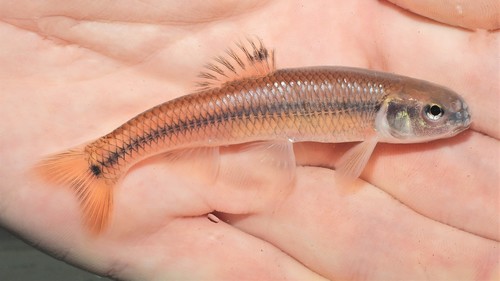
Bluntnose Minnow
Pimephales notatus
The Bluntnose Minnow is the unsung hero of North American waterways. Common, hardy, and surprisingly protective of its young, this little fish offers a fascinating window into the complex world of freshwater ecosystems.
Quick Identification
Size
2 to 4 inches (5 to 10 cm) in length; weighing less than 0.1 lbs (45g)
Colors
Dull olive to silvery-blue on top, silvery sides, and a white belly. A dark lateral stripe runs from the snout to a distinct spot at the tail.
Key Features
- Blunt, rounded snout that overhangs the mouth
- Small dark spot at the base of the tail fin
- Dark lateral line extending from the snout through the eye
- First ray of the dorsal fin is short and thickened
When You’ll See Them
Geographic range
Where Does the Bluntnose Minnow Live?
Native to the North American continent, the Bluntnose Minnow occupies a vast territory stretching from the Hudson Bay and Great Lakes basins down through the entire Mississippi River drainage system to the Gulf of Mexico. It is arguably the most common freshwater fish in the Eastern United States, with dense populations found from New York and the Appalachian Mountains westward to the Great Plains and northward into southern Canada. While primarily a resident of the central and eastern regions, its adaptability has allowed it to thrive in a wide variety of freshwater environments throughout its range.
Basemap © OpenStreetMap contributors
Behavior
The Bluntnose Minnow is a highly social and industrious species, often found in large, shimmering schools alongside other minnows and shiners. They are primarily bottom-dwellers, spending their days meticulously picking through sand, gravel, and organic debris for food. Their swimming style is characterized by short, rapid bursts followed by periods of hovering close to the substrate.
During the spawning season, males become remarkably territorial and diligent. They seek out the undersides of flat rocks, logs, or even submerged debris to create a nesting site. The male will use his head and fins to clean the surface before inviting females to lay eggs. Uniquely among many small fish, the male stays to guard the eggs, aggressively driving away predators and using his fins to fan oxygen-rich water over the nest until the fry hatch.
EverydayEarth exclusive
Camera Tips
To successfully capture the Bluntnose Minnow on camera, you will need a waterproof setup or an underwater action camera. Because these fish are bottom-feeders, placement is critical: position your camera on the floor of a stream or pond, ideally stabilized by a weighted mount or a flat rock. Angle the lens slightly upward or keep it parallel to the substrate to capture their natural foraging behavior. Look for 'structure' like large, flat rocks or submerged logs, as these are the preferred nesting sites for males during the spring.
If you are using a backyard pond or a shallow creek, you can encourage the fish to congregate in front of the lens by using a small amount of bait. A mesh 'chum bag' filled with crushed fish pellets or breadcrumbs can be tied just out of the frame; the scent will quickly draw a school of minnows into view. For the best results, ensure the water is clear and the sun is high in the sky (between 10 AM and 2 PM) to provide maximum light penetration and vibrant colors on their silvery scales.
During the late spring and early summer spawning season, keep a lookout for males that have developed small 'horns' (nuptial tubercles) on their snouts. These individuals are much more stationary than the rest of the school as they guard their nests. If you find a nest under a rock, set your camera to record in slow-motion or high frame rate (60fps+) to capture the intricate fin-fanning movements and the territorial displays they use to ward off other fish. This provides a rare, intimate look at fish behavior that is often missed by the casual observer.
Similar Species
Species that look similar or are commonly confused with Bluntnose Minnow.
Frequently Asked Questions
Record Bluntnose Minnow at your habitat
Connect a camera to start building your own species record — AI identifies every visitor automatically.