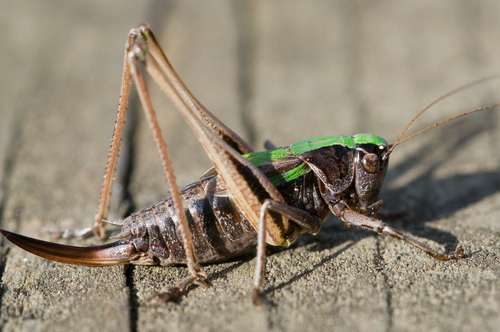
Bog Bush-cricket
Metrioptera brachyptera
A master of camouflage in Europe's wild wetlands, the Bog Bush-cricket sports a striking neon-green racing stripe against dark, earthy tones. Often heard before it is seen, its rhythmic ticking is the soundtrack of a healthy peat bog.
Quick Identification
Size
Body length 12-18 mm for males and 15-23 mm for females (0.5-0.9 inches)
Colors
Dark brown or blackish-brown flanks with a bright green or yellowish-green dorsal surface (back and top of head)
Key Features
- Bright green dorsal stripe contrasting with dark brown sides
- Short wings (brachypterous) reaching only halfway down the abdomen
- Upward-curving, sword-like ovipositor in females
- Pronotum has a crisp, pale border on the back edge
When You’ll See Them
Geographic range
Where Does the Bog Bush-cricket Live?
Native to the Palearctic region, the Bog Bush-cricket occupies a vast geographic range stretching across Europe and into temperate Asia. It is widely distributed from the British Isles and Western Europe through Central Europe and Scandinavia, extending as far east as Siberia and parts of Northern China. Within this range, it is highly localized, restricted to specific acidic wetland habitats that meet its humidity and temperature requirements.
Basemap © OpenStreetMap contributors
Behavior
The Bog Bush-cricket is a primarily diurnal insect, most active when the sun is high and warming its damp habitat. Unlike many other bush-crickets that prefer the canopy or tall shrubs, this species stays close to the ground, often perched on heather, rushes, or purple moor-grass. It is quite shy and will quickly drop into dense vegetation or rotate to the opposite side of a plant stem if it senses an approaching threat.
Males produce a distinctive song to attract mates, consisting of a rapid succession of short, high-pitched chirps that sound like a ticking watch. This stridulation is usually performed from a sunny vantage point. Despite their short wings, they are agile jumpers, using their powerful hind legs to escape predators like birds and spiders. In very hot summers, a rare long-winged form (macropterous) can occur, allowing the population to disperse to new territories.
EverydayEarth exclusive
Camera Tips
Capturing the Bog Bush-cricket requires a specialized approach due to its small size and ground-dwelling nature. We recommend using a trail camera with high-quality macro capabilities or a dedicated 'bug cam' setup. Place the camera very low to the ground, ideally 10–20 centimeters high, aimed at sunny patches within heather or rushes where these insects like to bask. Angle the camera slightly upward to capture the contrast between their green backs and dark sides.
Since these crickets are sensitive to movement, avoid placing cameras in areas with high wind that causes grass to whip across the lens, as this will trigger the sensor constantly and blur the subject. Look for 'song posts'—prominent stems or leaves that sit slightly above the surrounding foliage—as males will return to these spots repeatedly to sing during the afternoon heat.
While they are omnivorous, they aren't easily lured by traditional baits. Instead, focus on habitat: find a patch of Cross-leaved Heath or Purple Moor-grass in a damp area. The best time for recording is during August and September when the adults are most active and the males are vocal. High-speed video settings (60fps or higher) are excellent for capturing their rapid jumping movements or the vibration of their wings during stridulation.
Similar Species
Species that look similar or are commonly confused with Bog Bush-cricket.
Roesel's Bush-cricket
Distinguished by three pale spots on the side of the thorax and a more uniform yellowish-brown body without the bright green back.
Dark Bush-cricket
Larger and more uniformly brown, lacking the green dorsal stripe, and typically found in brambles and hedgerows rather than bogs.
Frequently Asked Questions
Record Bog Bush-cricket at your habitat
Connect a camera to start building your own species record — AI identifies every visitor automatically.