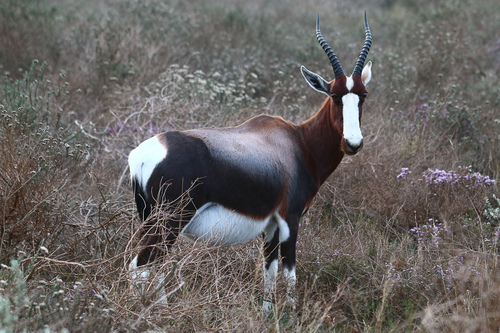
Bontebok/Blesbok
Damaliscus pygargus
Boasting a glossy purplish coat and a striking white facial blaze, the Bontebok and Blesbok are iconic figures of the South African plains. Once on the brink of extinction, these resilient antelopes now thrive as a centerpiece of backyard wildlife estates and open grasslands alike.
Quick Identification
Size
Shoulder height 85–100 cm (33–39 in); Weight 60–80 kg (130–175 lb)
Colors
Rich purplish-brown to chocolate coat; distinctive white blaze on face; white underbelly and rump; yellow-tinged legs in Blesbok, white in Bontebok
Key Features
- Lyre-shaped, S-curved horns on both sexes
- Stark white facial blaze from forehead to snout
- Glossy, dark brown coat with a purplish sheen
- White patch around the base of the tail
When You’ll See Them
Geographic range
Where Does the Bontebok/Blesbok Live?
The Bontebok and Blesbok are native to the southern African continent, specifically within the diverse landscapes of South Africa, Lesotho, and Namibia. The Bontebok subspecies is historically limited to the coastal fynbos and renosterveld regions of the Western Cape, while the Blesbok is widely distributed across the Highveld and inland plateaus. Today, through successful conservation and private ranching, these antelopes are found in many protected areas and even large suburban wildlife estates across the southern region.
Basemap © OpenStreetMap contributors
Behavior
Bontebok and Blesbok are highly social antelopes that are primarily active during the daylight hours. They are known for their distinctive "head-down" posture, where they stand facing the sun with their heads lowered, a behavior thought to help them avoid nasal botflies. Females and their offspring form small, stable nurseries, while mature males are territorial, using communal dung heaps called 'middens' to mark their boundaries. These territories are fiercely defended during the breeding season with displays of horn-clashing and ritualized movements.
While they are generally wary of humans, these animals have adapted well to managed environments like large estates and private game reserves. They are exceptionally fast runners, capable of reaching high speeds across open ground to evade predators. Unlike many other antelopes, they are poor jumpers and prefer to crawl under fences rather than leap over them, a behavioral trait that land managers must account for when designing wildlife-friendly boundaries.
EverydayEarth exclusive
Camera Tips
To get the best shots of Bontebok or Blesbok, mount your camera at roughly 3 feet (1 meter) above the ground. This height is perfect for capturing the striking white facial blaze and the elegant curve of their horns as they graze. Because they prefer open areas, avoid placing cameras in thick brush where the PIR sensor might be blocked; instead, target the edges of clearings or transition zones between tall and short grass.
Identifying a territory 'midden' is the most effective way to ensure a capture. These are areas of accumulated dung where males regularly return to mark their territory. If you find a flattened patch of grass near a midden, you've found a prime spot. Additionally, these antelopes are highly dependent on water, so a camera angled toward a shallow pond or a trough will provide excellent drinking and social interaction footage during the warmer parts of the day.
Set your camera to a multi-shot burst mode. These animals are prone to sudden, jerky movements and head-shaking to ward off flies; a single photo might result in a blurred face, but a 3-5 shot burst will likely catch that perfect, statuesque pose. Use a high-speed SD card to ensure the camera can write the images quickly enough for the next trigger, as they often travel in groups and you don't want to miss the trailing members of the herd.
Similar Species
Species that look similar or are commonly confused with Bontebok/Blesbok.
Frequently Asked Questions
Record Bontebok/Blesbok at your habitat
Connect a camera to start building your own species record — AI identifies every visitor automatically.