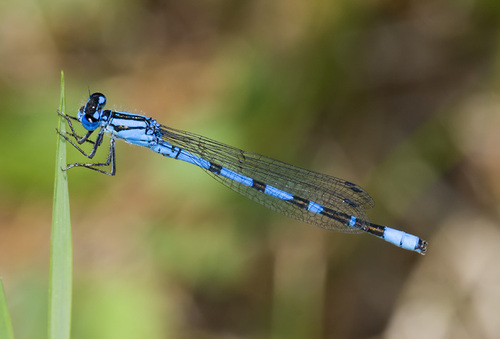
Boreal Bluet
Enallagma boreale
A hardy gem of the North, the Boreal Bluet brings a striking dash of sky-blue to backyard ponds and mountain wetlands alike. These delicate predators are the master aviators of the shoreline, dancing among the reeds throughout the summer months.
Quick Identification
Size
28–36 mm (1.1–1.4 inches) in length; wingspan of approximately 35–45 mm
Colors
Males are bright sky-blue with black bands; females are polymorphic, appearing either pale blue or olive-tan with heavy black markings
Key Features
- Mushroom-shaped black spot on the second abdominal segment (males)
- Large blue 'eyespots' on the back of the head
- Wide black humeral stripe on the thorax
- Delicate, needle-like body held horizontally when perched
When You’ll See Them
Geographic range
Where Does the Boreal Bluet Live?
Native to the northern reaches of North America, the Boreal Bluet is one of the most cold-tolerant damselfly species on the continent. Its range spans from the wilds of Alaska across the entirety of Canada, reaching down into the northern United States and following the high-altitude peaks of the Rocky Mountains as far south as New Mexico. It is a signature species of the boreal forest and alpine wetland ecosystems.
Basemap © OpenStreetMap contributors
Behavior
The Boreal Bluet is a quintessential 'pond damselfly,' known for its delicate, dancing flight over the surface of still waters. Unlike their more robust dragonfly cousins, these damselflies prefer to stay close to the shoreline, frequently perching on emergent vegetation like sedges or lily pads to rest and survey for prey. They are most active during the warmest hours of the day, using their large compound eyes to track tiny flying insects.
Socially, they are often seen in 'tandem pairs,' where the male uses specialized appendages to grasp the female behind the head. This behavior is a common sight in late spring and summer, as the pair flies together to find suitable submerged plants where the female can deposit her eggs. They are completely harmless to humans and provide a great service by keeping local gnat and mosquito populations in check.
EverydayEarth exclusive
Camera Tips
Capturing the Boreal Bluet on camera requires a focus on 'perch points' rather than open air. These damselflies have favorite stalks of grass or reeds where they return repeatedly to rest. Position your camera about 1 to 2 feet away from emergent vegetation at the edge of a pond. Using a macro lens or a camera with a short minimum focus distance is essential to capture the intricate black 'mushroom' patterns on their blue abdomens.
Lighting is your best friend when filming these metallic-colored insects. Aim for a 45-degree angle relative to the sun to highlight the translucency of their wings and the vibrancy of their blue bodies. If your camera has a high-speed video mode (60fps or higher), use it; while their flight looks slow to us, their wingbeats are incredibly fast and look stunning in slow motion.
To attract them to a specific spot for your camera, ensure there is a clear, sun-drenched 'landing pad'—a flat leaf or a sturdy vertical reed—near the water's edge. Avoid using artificial baits, as damselflies are visual hunters and respond only to the movement of live prey or the presence of a suitable habitat. Early afternoon on a windless day is the peak window for the best footage, as they will be most active and less likely to be tossed around by breezes.
Similar Species
Species that look similar or are commonly confused with Boreal Bluet.
Northern Bluet
Almost identical, but the Northern Bluet has slightly different black markings on the second abdominal segment and prefers slightly warmer habitats.
Familiar Bluet
The Familiar Bluet has much more blue on its abdomen, specifically segments 4 and 5 are almost entirely blue.
Tule Bluet
Found in similar habitats but has larger black markings on the sides of the thorax and different abdominal patterns.
Frequently Asked Questions
Record Boreal Bluet at your habitat
Connect a camera to start building your own species record — AI identifies every visitor automatically.