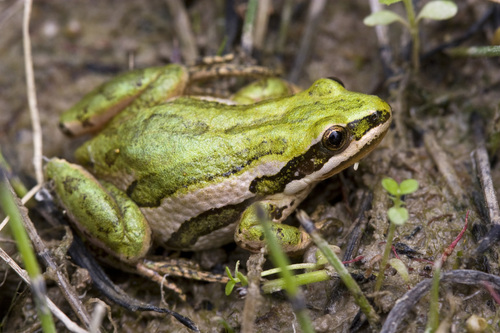
Boreal Chorus Frog
Pseudacris maculata
The Boreal Chorus Frog is the tiny, striped messenger of spring. Though no bigger than a paperclip, their collective voice can fill a landscape, signaling the end of winter across the North American wilds.
Quick Identification
Size
1.9 to 3.8 cm (0.75 to 1.5 inches) in length; weight typically ranges from 1 to 5 grams
Colors
Back is usually grey, olive, or brown with three dark, often broken longitudinal stripes; a dark stripe runs through the eye, and a white line marks the upper lip.
Key Features
- Three dark longitudinal stripes on the back
- Dark mask-like stripe running through the eye
- White line along the upper lip
- Blunt snout and small toe pads
When You’ll See Them
Geographic range
Where Does the Boreal Chorus Frog Live?
The Boreal Chorus Frog is a resilient North American native with a vast range extending from central Quebec across to the Canadian Rockies and north into the Northwest Territories and Yukon. In the United States, they are found throughout the Great Plains and Midwest, from Minnesota and Montana down to the mountainous regions of Arizona and New Mexico. They are remarkably adaptable, living in both low-lying wetlands and high-altitude alpine meadows.
Basemap © OpenStreetMap contributors
Behavior
The Boreal Chorus Frog is famously known as the 'harbinger of spring.' They are among the first amphibians to emerge and begin calling, often while snow and ice are still present on the ground. Their call—a rising, raspy 'crreeeeeek'—is frequently compared to the sound of a fingernail running across the teeth of a plastic comb. While they are loud and bold when calling in a group, they are extremely shy; a single heavy footstep can cause an entire pond of frogs to go silent instantly.
Outside of the breeding season, these frogs are primarily terrestrial and secretive. They spend most of their time in damp leaf litter or low-lying vegetation. Unlike many other members of the treefrog family, they are not great climbers and prefer to stay near the ground. During the winter, they exhibit incredible resilience by hibernating under logs or leaf litter, where they can survive partial freezing of their body tissues thanks to natural cryoprotectants in their blood.
EverydayEarth exclusive
Camera Tips
Capturing a Boreal Chorus Frog on camera requires a specialized approach because of their tiny size and cold-blooded nature. Most standard trail cameras use Passive Infrared (PIR) sensors that trigger based on heat and motion; since these frogs don't emit significant heat, they rarely trigger a camera. To solve this, set your camera to 'Time-Lapse' mode during the spring breeding season, capturing an image every 30 to 60 seconds near the edge of a pond or drainage ditch.
For the best perspective, mount your camera just 2–5 inches off the ground. A wide-angle lens with a short focal distance is ideal, as these frogs are small and you'll want the camera close to where they sit. Look for 'calling perches'—small sticks or clumps of grass emerging from shallow water. During the spring, males will return to the same spot night after night to call, giving you a predictable target for your lens.
If you are using an AI-powered camera in a backyard setting, place it near a 'frog log' or a shallow water feature. You can attract them by keeping a corner of your yard damp with leaf litter and native grasses. Night shots are often the most dramatic, as the frog's vocal sac expands into a large, translucent bubble when calling. Ensure your camera's flash isn't too overpowering at close range; using a piece of semi-transparent tape over the LED can help soften the light for these tiny subjects.
Similar Species
Species that look similar or are commonly confused with Boreal Chorus Frog.
Western Chorus Frog
Nearly identical in appearance, but the Boreal Chorus Frog generally has shorter hind legs and a different geographic range (further north and west).
Spring Peeper
Similar size and habitat, but identified by a distinct dark 'X' on the back rather than longitudinal stripes.
Wood Frog
Larger than the chorus frog and lacks the three long stripes, instead featuring a prominent dark brown 'robber's mask' over the eyes.
Frequently Asked Questions
Record Boreal Chorus Frog at your habitat
Connect a camera to start building your own species record — AI identifies every visitor automatically.