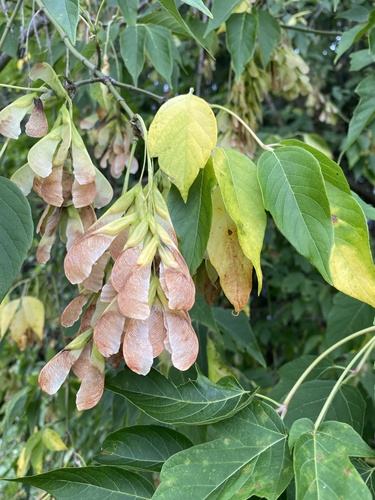
box elder
Acer negundo
Often called the 'Manitoba Maple,' the Box Elder is a fast-growing North American native that bridges the gap between wild forests and suburban backyards. It is a vital winter food source for birds and the primary host for the striking red-and-black Boxelder bug.
Quick Identification
Size
Height: 10–25 m (30–80 ft); Trunk diameter: 30–100 cm (12–40 in)
Colors
Bright green new growth, grey-brown furrowed bark, and pale yellow autumn foliage; female trees produce tan, winged seeds
Key Features
- Pinnately compound leaves with 3-7 leaflets (often resembling poison ivy)
- Distinctive green or purplish waxy twigs on new growth
- Pairs of winged seeds (samaras) that hang in drooping clusters
- Dioecious—individual trees are either male or female
- Fast-growing with a broad, often irregular or leaning crown
When You’ll See Them
Geographic range
Where Does the box elder Live?
The Box Elder is a resilient native of North America, stretching its branches from the southern reaches of Canada all the way down through the United States and into Mexico and Guatemala. It is most at home in the eastern and central regions of the US but has successfully naturalized across much of the globe, including parts of Europe, Asia, and South America. Whether clinging to a riverbank in the Midwest or providing shade in a suburban garden, this adaptable tree thrives in a variety of temperate climates.
Basemap © OpenStreetMap contributors
Behavior
As a pioneer species, the Box Elder is a master of opportunistic growth. Unlike many maples, it thrives in disturbed soils and riverside environments, growing rapidly to outcompete neighbors in sunny gaps. It is unique among North American maples for being dioecious, meaning individual trees are either male or female. This makes the female trees particularly attractive to wildlife during the winter months when they hold onto their drooping clusters of seeds long after the leaves have fallen.
While it is sometimes considered 'weedy' due to its brittle wood and tendency to sprout in sidewalk cracks or along fence lines, the Box Elder provides vital structure to early-successional ecosystems. It shares a famous relationship with the Boxelder Bug, which feeds on its seeds. For homeowners, it serves as a robust shade tree, though its rapid growth often results in a shorter lifespan compared to sturdier hardwoods like oaks or sugar maples.
EverydayEarth exclusive
Camera Tips
Capturing the life around a Box Elder requires focusing on its role as a seasonal 'wildlife hub.' Because female trees hold their winged samaras through the winter, they are magnets for birds like evening grosbeaks and mammals like squirrels and chipmunks. Position your camera at a slight upward angle toward the lower branches or the trunk where seed clusters hang lowest. During winter, a camera aimed at the base of the tree can capture foragers scouring the snow for fallen seeds.
For those interested in insect life, the Box Elder is the best place to set up a macro-lens trail camera. In late summer and fall, you can capture the social aggregation of Boxelder bugs on the sunny side of the trunk. Mount your camera on a nearby post or a sturdy branch about 3-5 feet off the ground, ensuring it faces the south or west to catch the warmth of the afternoon sun, which attracts these colorful red-and-black insects in large numbers.
Timelapse mode is particularly rewarding with this species. Its rapid growth makes it an excellent candidate for a 'season-lapse.' Secure your camera in a weatherproof housing on a permanent structure (like a fence post) and set it to take one photo a day at noon. Over several months, you'll see the dramatic transition from the lime-green compound leaves of spring to the heavy seed clusters of late summer and the stark, green-twigged silhouette of winter. This method also helps identify which specific branches are the most popular perches for visiting birds.
Similar Species
Species that look similar or are commonly confused with box elder.
Frequently Asked Questions
Record box elder at your habitat
Connect a camera to start building your own species record — AI identifies every visitor automatically.