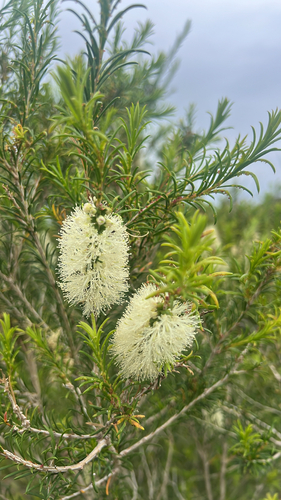
Bracelet Honey-myrtle
Melaleuca armillaris
A coastal icon of south-eastern Australia, the Bracelet Honey-myrtle is a magnet for honeyeaters and a master of the salt-swept cliffside.
Quick Identification
Size
Height of 5–8 metres (16–26 feet) with a spread of 4–6 metres (13–20 feet)
Colors
Dark green foliage, creamy-white to pale yellow flowers, and grey-brown furrowed bark
Key Features
- Dense, needle-like leaves with tiny hooked tips
- Cylindrical cream flower spikes up to 8cm long
- Rough, deeply fissured papery bark
- Weeping or pendulous branch tips
When You’ll See Them
Geographic range
Where Does the Bracelet Honey-myrtle Live?
Native to the continent of Australia, the Bracelet Honey-myrtle is a staple of the south-eastern coastline. Its core range spans from the coastal regions of New South Wales through Victoria and into south-eastern South Australia, including the islands of Tasmania. Due to its popularity in landscaping, it has successfully naturalized in parts of Western Australia and Queensland, where it thrives in Mediterranean and temperate climates.
Basemap © OpenStreetMap contributors
Behavior
The Bracelet Honey-myrtle is a remarkably resilient and fast-growing large shrub or small tree. In the wild, it acts as a pioneer species, often colonizing coastal cliffs and estuarine edges where salt spray and wind would deter less hardy plants. Its dense, fine-textured canopy provides excellent nesting sites for small birds, offering protection from larger predators and the elements.
In a backyard setting, this species is a hub of social activity for local fauna. During its prolific flowering season in late spring and summer, it becomes a high-traffic nectar station. It interacts with humans primarily as a popular 'screen' plant, providing privacy while simultaneously serving as a bridge for wildlife moving through suburban corridors. Its root system is robust, making it a favorite for erosion control on sloping properties.
EverydayEarth exclusive
Camera Tips
To capture the incredible biodiversity that visits the Bracelet Honey-myrtle, place your AI camera at mid-canopy height, approximately 1.5 to 2 metres from the ground. Aim the lens at a cluster of developing flower spikes. Because the foliage is dense and needle-like, avoid placing the camera too deep inside the branches, as the 'busy' background can sometimes confuse autofocus or motion sensors; instead, position it on the outer edge of the canopy where birds land before feeding.
The best time for capturing high-action footage is during the morning hours (7 AM to 10 AM) when nectar production is at its peak and honeyeaters are most active. For trail cameras, use a high-speed trigger setting to catch the rapid movements of New Holland Honeyeaters or Eastern Spinebills. If you are looking for nocturnal visitors, this tree is a favorite thoroughfare for Common Ringtail Possums, so ensure your infrared night vision is enabled.
During the peak flowering months of November and December, consider setting your camera to 'Time-Lapse' mode for a few hours. This allows you to observe the transition from bud to full 'bottlebrush' bloom and the sheer volume of insect pollinators—including native bees and hoverflies—that frequent the tree. If your camera allows for sensitivity adjustments, set it to medium to avoid false triggers from the tree's fine, weeping branches moving in the wind.
Frequently Asked Questions
Record Bracelet Honey-myrtle at your habitat
Connect a camera to start building your own species record — AI identifies every visitor automatically.