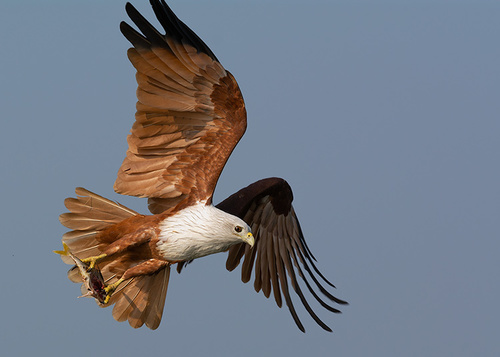
Brahminy Kite
Haliastur indus
With its striking snow-white head and rich chestnut plumage, the Brahminy Kite is one of the most recognizable raptors of the tropical coast. Often seen soaring above estuaries and shorelines, this 'sea eagle' is as much a scavenger as it is a hunter.
Quick Identification
Size
Length: 44–52 cm (17–20 in); Wingspan: 109–124 cm (43–49 in); Weight: 320–670 g (11–24 oz)
Colors
Striking contrast between the bright white head, neck, and breast and the rich chestnut-reddish plumage of the body and wings. Primary flight feathers are black-tipped.
Key Features
- Distinctive white head and chest contrasting with chestnut body
- Deeply rounded or fan-shaped tail during flight
- Strong, pale yellowish hooked beak
- Black primary wing tips visible in flight
When You’ll See Them
Geographic range
Where Does the Brahminy Kite Live?
The Brahminy Kite is native to a vast stretch across the Indo-Pacific region, spanning from the Indian subcontinent through Southeast Asia and down into Australia. It thrives in the tropical and subtropical belts, with core populations established in countries like India, Thailand, Indonesia, and the northern coasts of Australia. While largely coastal, they have expanded inland along major river systems and are common sights in urbanized waterfronts throughout their range.
Basemap © OpenStreetMap contributors
Behavior
Brahminy Kites are graceful flyers often seen soaring effortlessly over coastal areas or perched on high branches overlooking water. While they are raptors, they are highly opportunistic scavengers, often acting as the 'clean-up crew' of the shoreline by snatching up dead fish or offal. They are generally solitary but can congregate in large numbers at fish markets or rubbish tips where food is abundant.
Unlike many other birds of prey, they are relatively bold around human settlements, often nesting in tall trees within suburban gardens or parks near water. Their call is a distinctive, nasal 'pee-ah-ah,' which is a familiar sound across many tropical coastlines. They spend much of their day patrolling the skies, using their keen eyesight to spot morsels on the water's surface or the ground below.
EverydayEarth exclusive
Camera Tips
To capture a Brahminy Kite on your backyard or trail camera, focus on height and visibility. These birds are perching raptors, so placing your camera at an elevated angle—ideally 10 to 15 feet high—facing a prominent dead branch or an open fence post near water will yield the best results. If you live near a canal or estuary, aim the camera toward the waterline where they often swoop down to grab prey. Ensure the camera has a clear line of sight, as their broad wingspan can cause motion blur if they have to navigate through dense foliage.
While we don't recommend feeding wild raptors, if you are in a legal and safe area to do so, a 'lure' of fresh fish scraps placed on an open platform or a flat rock can be very effective. Ensure the bait is secured so it isn't carried off immediately, giving your AI camera time to trigger. Because these birds are most active during the brighter hours of the day, set your camera to high-speed shutter mode if available to freeze the action of their dramatic descents.
Seasonality plays a role in their visibility; during the breeding season (which varies by region, but often follows the monsoon), they become more territorial and frequent specific nesting trees. Look for large stick nests in tall trees and position your camera to monitor the flight paths leading to the nest. For camera settings, use a fast trigger speed (0.2s or less) and consider burst mode to capture the moment they extend their talons. Since they have bright white heads, adjust your exposure settings slightly downward to avoid 'blowing out' the highlights in direct tropical sun.
Similar Species
Species that look similar or are commonly confused with Brahminy Kite.
Black Kite
Uniformly dark brown plumage and a noticeably forked tail, lacking the white head of the Brahminy Kite.
Whistling Kite
Found in Australia; has a much lighter, sandy-brown color and lacks the sharp white-and-chestnut contrast.
White-bellied Sea-eagle
Significantly larger with a much shorter, wedge-shaped tail and grey wings instead of chestnut.
Frequently Asked Questions
Record Brahminy Kite at your habitat
Connect a camera to start building your own species record — AI identifies every visitor automatically.