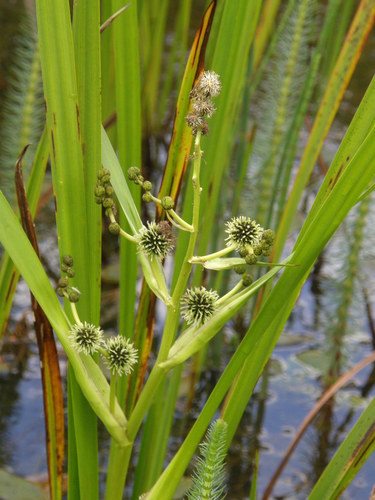
Branched Bur-reed
Sparganium erectum
A structural masterpiece of the water's edge, the Branched Bur-reed provides essential 'high-rise' housing for dragonflies and a safe haven for nesting waterfowl.
Quick Identification
Size
Height of 60-150 cm (24-60 inches); leaves 1-2 cm (0.4-0.8 inches) wide.
Colors
Bright lime-green foliage; flower heads start pale green and mature into dark brown or charcoal-colored spiky fruit clusters.
Key Features
- Branched flowering stems with multiple globular heads
- Spiky, bur-like fruit clusters that turn dark brown when ripe
- Long, strap-like leaves with a distinct triangular cross-section at the base
- Separate male (fuzzy, upper) and female (spiky, lower) flower clusters.
When You’ll See Them
Geographic range
Where Does the Branched Bur-reed Live?
The Branched Bur-reed is native across the temperate regions of Europe, North Africa, and much of Asia. It thrives in the wetlands of the British Isles and mainland Europe, extending through Russia to China and Japan. While primarily a Palearctic species, it is often found in managed water systems like bioswales and canals across its native range due to its resilience and ability to colonize disturbed wet ground.
Basemap © OpenStreetMap contributors
Behavior
In the backyard pond or local wetland, it acts as a natural water purifier. Its aggressive growth allows it to absorb significant amounts of excess nitrogen and phosphorus, helping to prevent algae blooms. While it remains stationary, it is a hub of biological activity, constantly swaying in the breeze and providing a stage for various predators and prey to interact.
EverydayEarth exclusive
Camera Tips
To capture the architectural beauty of the Branched Bur-reed, position your camera at a low angle (roughly 2 feet off the ground) near the water's edge. Focus the lens on the unique 'bur' seed heads, which provide excellent texture for high-definition photography. A slight upward tilt will help frame the plant against the sky, highlighting its structural silhouette and the vibrant green of its strap-like leaves.
Because this plant is a magnet for dragonflies and damselflies, use a camera with a fast trigger speed or set it to record high-frame-rate video. These insects often use the tall stems as perches for hunting or as platforms for emerging from their larval stage. Mid-morning to early afternoon is the best time for this, as the sun provides enough light to capture the iridescent wings of visiting insects against the green backdrop of the bur-reed.
For those interested in capturing larger wildlife, place your camera facing a gap in a bur-reed stand. Water birds like moorhens and ducks often use these 'corridors' to enter and exit the water. If you are using an AI-powered trail camera, configure the motion detection zone to include the area where the stems meet the water surface, as this is where you are most likely to trigger captures of water voles or frogs moving through the vegetation.
Similar Species
Species that look similar or are commonly confused with Branched Bur-reed.
Frequently Asked Questions
Record Branched Bur-reed at your habitat
Connect a camera to start building your own species record — AI identifies every visitor automatically.