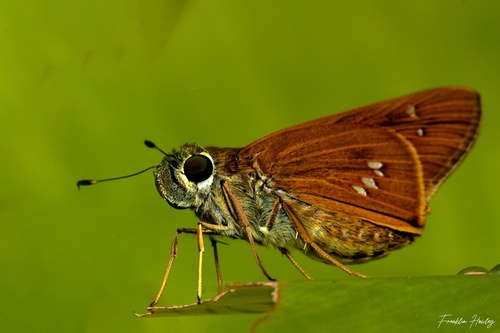
Brazilian Skipper
Calpodes ethlius
With their moth-like bodies and translucent wing 'windows,' Brazilian Skippers are the speed-demons of the butterfly world. Watch for them darting through Canna lily patches with unmatched agility.
Quick Identification
Size
Wingspan of 45–60 mm (1.75–2.35 inches)
Colors
Dull chocolate-brown wings with several translucent white spots on the forewings and a distinct row of three or four white spots on the hindwings.
Key Features
- Large, robust brown body with a moth-like appearance
- Linear row of translucent white spots on the hindwings
- Extremely fast, darting flight pattern
- Caterpillars found inside rolled Canna lily leaves
When You’ll See Them
Geographic range
Where Does the Brazilian Skipper Live?
The Brazilian Skipper is primarily a resident of South and Central America, spanning from Argentina up through Mexico and the West Indies. In the United States, it is a permanent resident in southern Florida and southern Texas, where the climate remains warm enough to support its host plants year-round. During the summer months, adventurous individuals frequently stray northward, establishing temporary breeding colonies as far north as Illinois, Nebraska, and even Massachusetts, though these populations typically vanish with the arrival of winter frost.
Basemap © OpenStreetMap contributors
Behavior
A fascinating aspect of this species is its reproductive behavior centered around Canna lilies. Females lay their eggs on the leaves, and once hatched, the larvae—known as Canna leafrollers—use silk to bind the edges of the leaves together. This creates a protective tube where the caterpillar hides during the day to avoid predators, emerging only to feed on the surrounding foliage. In a backyard setting, you may notice the distinctive 'cut and fold' pattern on your lilies before you ever see the adult butterfly.
EverydayEarth exclusive
Camera Tips
To capture the Brazilian Skipper on an AI-powered camera, the 'host plant strategy' is your best bet. Position your camera approximately 2 to 3 feet off the ground, aimed directly at a stand of Canna lilies. Because these butterflies are lightning-fast, you should set your camera to its highest trigger speed or use a video mode. Focus the lens on the flowering tops or the uppermost leaves where adults are most likely to land for nectar or egg-laying.
Since skippers are most active in the heat of the day, lighting can be a challenge. Try to place your camera so the sun is behind it, illuminating the lilies without creating a silhouette effect. If your camera has a 'time-lapse' or 'burst' setting, utilize it during the peak hours of 11 AM to 3 PM. These insects don't linger long on a single bloom, so a single photo might miss the action while a short 10-second video clip will capture their frantic, energetic feeding behavior.
For a unique perspective, you can also set up a camera for 'micro-activity' near the rolled leaves. Look for leaves that have been folded over and silk-fastened. By placing a camera with a close-focus capability near these shelters, you might catch the translucent green caterpillar emerging to feed at twilight, or even the adult butterfly emerging from its chrysalis, which usually happens inside those same leaf tubes. Avoid using bright artificial lures; instead, ensure your Canna lilies are well-watered, as healthy plants produce more nectar and are more attractive to these high-energy fliers.
Similar Species
Species that look similar or are commonly confused with Brazilian Skipper.
Frequently Asked Questions
Record Brazilian Skipper at your habitat
Connect a camera to start building your own species record — AI identifies every visitor automatically.