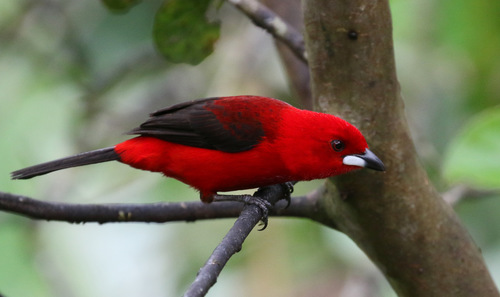
Brazilian Tanager
Ramphocelus bresilius
The Brazilian Tanager is a living jewel of the Atlantic Forest, famous for the male's breathtaking crimson plumage. A frequent visitor to coastal gardens, this social bird is a favorite for backyard observers and photographers alike.
Quick Identification
Size
Length of 18-19 cm (7-7.5 in); weight between 28-35 g (1-1.2 oz)
Colors
Males are brilliant crimson-red with black wings and tail; females are duller brownish-grey with reddish-brown underparts.
Key Features
- Intense crimson-red body plumage in males
- Bright white patch at the base of the lower mandible
- Black wings and tail contrasting with red body
- Short, thick conical bill
- Social behavior often seen in pairs
When You’ll See Them
Geographic range
Where Does the Brazilian Tanager Live?
Native to the eastern coast of South America, the Brazilian Tanager is a signature species of the Atlantic Forest biome. Its range extends primarily through eastern Brazil, from the state of Paraíba south to Santa Catarina, and reaches into the northeastern tip of Argentina in the Misiones province. It thrives in humid coastal lowlands and is rarely found far inland or at high altitudes.
Basemap © OpenStreetMap contributors
Behavior
The Brazilian Tanager, known locally in Brazil as the Tiê-sangue, is a high-energy songbird that brings a burst of color to the Atlantic Forest. They are remarkably social and are rarely found alone, typically moving through the undergrowth and mid-canopy in pairs or small family groups. Their movement is characterized by quick hops and frequent tail-flicking as they search for food among the foliage.
In suburban environments, these birds show a surprising amount of bold curiosity. They are frequent visitors to backyard bird tables and are often among the first species to arrive when fresh fruit is put out. Despite their bright appearance, they can be elusive in dense shadows, but their constant, sharp call notes usually give their location away before they are seen.
EverydayEarth exclusive
Camera Tips
To capture the stunning crimson of a male Brazilian Tanager, place your camera at a height of 3 to 5 feet, targeting low-hanging fruit-bearing shrubs or a dedicated bird table. These birds prefer foraging in the mid-to-lower canopy, so angling the camera slightly upward towards a popular perch or downward toward a feeder works best. They are creature of habit and will return to the same feeding spots daily.
Since these birds are heavily attracted to fruit, a 'feeder cam' setup is highly effective. Offer halved papayas, overripe bananas, or oranges to lure them into the frame. Position the camera about 4-6 feet away from the bait to ensure the focus is sharp; because they are small, getting too close might trigger the PIR sensor too late, resulting in 'empty' photos as the bird flits away.
Use high-speed burst modes or short video clips (10-15 seconds) because tanagers are fast and rarely stay still while feeding. Early morning light provides the best color accuracy for their red feathers; direct midday sun can often overexpose the bright plumage, causing a 'blooming' effect in the image that loses feather detail.
In backyard settings, ensuring a nearby water source like a birdbath will also increase your chances of unique captures. They are frequent bathers, and a camera focused on a shallow water feature can capture spectacular splashing sequences that you won't see at a fruit feeder. Ensure the water is no more than 2 inches deep to keep them comfortable.
Similar Species
Species that look similar or are commonly confused with Brazilian Tanager.
Frequently Asked Questions
Record Brazilian Tanager at your habitat
Connect a camera to start building your own species record — AI identifies every visitor automatically.