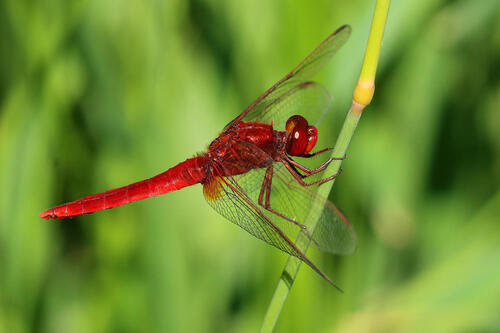
Broad Scarlet
Crocothemis erythraea
The Broad Scarlet is a living ember of the insect world, known for its dazzling red hue and bold, territorial nature. A master of the summer sky, it is one of the most vibrant visitors you can attract to a garden pond.
Quick Identification
Size
Length of 36–45 mm (1.4–1.8 in) with a wingspan of 60–70 mm (2.4–2.8 in)
Colors
Males are a brilliant, uniform scarlet red; females are yellowish-brown with a distinct pale stripe between the wing bases.
Key Features
- Vivid scarlet red body and eyes (males)
- Broad, flattened abdomen
- Amber-tinted patch at the base of the hindwings
- Pale mid-dorsal stripe on the thorax (females/immatures)
When You’ll See Them
Geographic range
Where Does the Broad Scarlet Live?
The Broad Scarlet is a widespread species natively found throughout Africa, Southern Europe, and Western Asia. In recent years, it has become a poster species for northward range expansion, moving steadily into Central and Northern Europe, including the United Kingdom and Scandinavia. This hardy dragonfly thrives in almost any sunny wetland environment, from Mediterranean coastal marshes to suburban garden ponds in the temperate north.
Basemap © OpenStreetMap contributors
Behavior
The Broad Scarlet is a classic "percher" dragonfly, meaning it spends a significant amount of its time resting on prominent lookout points rather than patrolling in constant flight. From these sun-drenched perches, territorial males vigilantly guard their turf, darting out with incredible speed to intercept rival males or to snatch flying prey from the air before returning to the exact same spot.
These dragonflies are intensely heliophilic, or sun-loving. On particularly hot days, you may observe them performing a behavioral feat known as the "obelisk posture," where they raise their abdomen vertically toward the sun. This minimizes the surface area exposed to direct heat, helping them regulate their body temperature while staying active in the peak of summer.
EverydayEarth exclusive
Camera Tips
To capture high-quality footage of the Broad Scarlet, you must think like a territorial male. These dragonflies have favorite "thrones"—usually a vertical reed, a dry stick, or a garden stake that sits in full sunlight near the water. Position your AI camera on a tripod or mount it to a nearby structure, focusing the lens specifically on the tip of one of these perches. Because they return to the same spot repeatedly, you can wait for the AI to trigger once they land.
Since dragonflies are most active during the brightest parts of the day, lighting is rarely an issue, but glare can be. Try to position your camera with the sun at your back to illuminate the brilliant red pigments of the male's body. If your camera allows for manual shutter speed settings, aim for 1/2000th of a second or higher to freeze the motion of their wings if you hope to catch them during takeoff or landing.
Avoid placing the camera where its shadow will fall across the perch, as the Broad Scarlet is highly sensitive to sudden changes in light and movement. If you are using a backyard camera near a pond, adding a few bamboo stakes in the water can act as a lure, providing the perfect stage for the dragonfly to pose for your lens. Macro settings are ideal here, as the intricate vein patterns in their wings and their large compound eyes provide stunning detail when captured up close.
Similar Species
Species that look similar or are commonly confused with Broad Scarlet.
Frequently Asked Questions
Record Broad Scarlet at your habitat
Connect a camera to start building your own species record — AI identifies every visitor automatically.