Broad Sword Fern
Nephrolepis biserrata
A prehistoric giant of the understory, the Broad Sword Fern transforms any shaded corner into a lush, tropical sanctuary. With fronds that can tower over a human, it is the ultimate habitat for backyard biodiversity.
Quick Identification
Size
Fronds typically reach lengths of 1.2 to 2.5 meters (4 to 8 feet) and widths of up to 30 centimeters (12 inches).
Colors
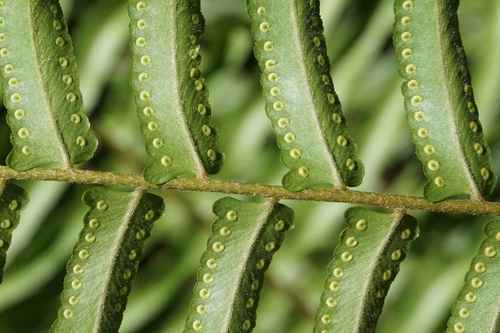
Bright to deep emerald green foliage; brownish scales along the stipe (stem); circular brown or orange spore clusters (sori) on leaf undersides.
Key Features
- Massive, arching fronds reaching up to 8 feet in length
- Leaflets (pinnae) feature finely toothed or 'double-serrated' margins
- Large, circular sori arranged in rows near the edges of the pinnae
- Growth habit can be terrestrial, epiphytic (on trees), or lithophytic (on rocks)
When You’ll See Them
Geographic range
Where Does the Broad Sword Fern Live?
The Broad Sword Fern is a true citizen of the tropics, natively found across a vast global belt including South and Central America, Africa, and Southeast Asia. In North America, its core range is centered in the humid heat of Florida and the West Indies, where it is often found clinging to the trunks of Sabal palms or carpeting the floor of moist hammocks. It has also been introduced to various other tropical islands and warm-temperate regions, where it frequently escapes cultivation due to its hardy nature.
Basemap © OpenStreetMap contributors
Behavior
The Broad Sword Fern is a vigorous evergreen perennial that plays a vital role in tropical ecosystems. Unlike many smaller ferns, this species is known for its sheer scale, often creating dense, fountain-like clumps that provide essential structural cover for ground-dwelling wildlife. It spreads primarily through underground rhizomes and long, thin runners, allowing it to colonize large areas and form lush thickets in humid environments.
While it is a passive organism, its interaction with the environment is dynamic; it effectively captures moisture from the air and provides a micro-habitat for diverse fauna. In backyard settings, it acts as a 'nursery' plant, where tree frogs, small lizards, and various insects seek refuge from the heat and predators. It is highly adaptable, though it thrives best in filtered light where its massive fronds can stretch toward the canopy without being scorched by direct sun.
EverydayEarth exclusive
Camera Tips
Capturing the Broad Sword Fern on a backyard or trail camera requires a focus on composition and timing rather than movement triggers. To truly showcase the plant's 'giant' stature, place your camera at a low angle (about 12-18 inches off the ground) pointed slightly upward. This perspective emphasizes the dramatic arch of the 8-foot fronds. Because ferns don't move much, use your camera’s 'Time Lapse' mode to document the slow unfurling of new 'fiddleheads' over several weeks, which provides a fascinating look at plant development that many people never see.
Lighting is your best friend when photographing this species. Position your camera so it is facing toward the sun but shielded by the canopy; this creates 'backlighting,' which makes the translucent green fronds appear to glow and highlights the intricate patterns of the sori (spore cases) on the underside of the leaves. The best times for this are the first and last two hours of daylight. Avoid using a heavy flash at night, as the reflective surface of the leaves can cause significant glare and blow out the details of the plant's texture.
Finally, remember that the Broad Sword Fern is a wildlife magnet. Instead of just focusing on the plant, aim your camera at a specific gap in the fronds or a large leaf that catches the light. Small vertebrates like Green Anoles and various Tree Frog species frequently use these leaves as hunting platforms or sleeping quarters. By setting your camera to a high-sensitivity motion trigger and using a macro lens attachment if available, you can capture the hidden animal life that calls your fern home.
Similar Species
Species that look similar or are commonly confused with Broad Sword Fern.
Frequently Asked Questions
Record Broad Sword Fern at your habitat
Connect a camera to start building your own species record — AI identifies every visitor automatically.