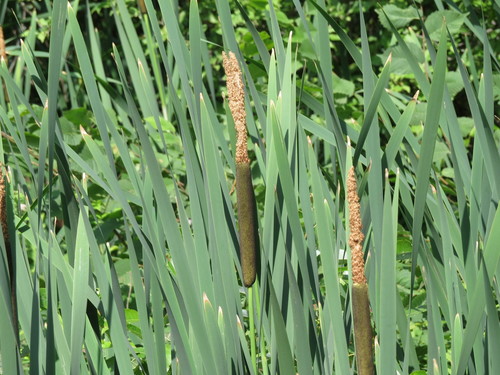
broadleaf cattail
Typha latifolia
The iconic architect of the marsh, the broadleaf cattail is more than just a plant—it's a bustling wildlife skyscraper. From its velvet-brown spikes to its deep starchy roots, it provides food and shelter for a vast array of backyard creatures.
Quick Identification
Size
Stems reach 1.5–3 meters (5–10 feet) in height; leaves are 10–25 mm (0.4–1 inch) broad.
Colors
Soft green foliage; flower spikes turn from green to a deep, velvety chocolate-brown; fluffy white seed down in autumn.
Key Features
- Broad, flat, sword-like leaves
- Dense, cigar-shaped brown flower spike
- No gap between male and female flower parts
- Thick, starchy underground rhizomes
When You’ll See Them
Geographic range
Where Does the broadleaf cattail Live?
The broadleaf cattail is one of the most widely distributed plants on Earth, native to almost the entire Northern Hemisphere. It is found throughout North America from Alaska to Mexico and across most of Eurasia. While it is indigenous to parts of Africa and South America, it has also expanded into new territories where it is sometimes considered an opportunistic colonizer of disturbed wetlands.
Basemap © OpenStreetMap contributors
Behavior
The broadleaf cattail is a foundational species in wetland ecosystems, acting as both a primary producer and a physical architect of the marsh. It spreads aggressively through a network of creeping rhizomes, often forming dense, monocultural stands known as "cattail marshes." These stands provide critical structure for the environment, stabilizing soft mud banks and filtering toxins from the water column.
While stationary, the plant exhibits a fascinating seasonal cycle. In early summer, it produces its iconic flower spikes—the top yellow portion is the male pollen-producer, while the lower green-turning-brown portion is the female fruit. By autumn, the male portion withers, and the female spike can release up to 250,000 tiny, tufted seeds that travel on the wind like snow. For humans, the cattail has long been known as a "survivalist's supermarket," as almost every part of the plant is edible or useful at different stages of its growth.
EverydayEarth exclusive
Camera Tips
When setting up a camera near broadleaf cattails, you aren't just filming a plant—you are filming a high-traffic wildlife hub. To capture the best action, position your camera on a sturdy stake or a nearby tree about 2 to 3 feet off the ground, angled toward the edge of the cattail stand where it meets open water. This is a prime transition zone for mammals like muskrats and minks, who use the stalks for cover and food.
Because cattail leaves catch the wind easily, avoid using standard motion-trigger settings, which can lead to thousands of "false positive" videos of swaying grass. Instead, utilize a "Time Lapse" mode during the early morning hours (6:00 AM to 9:00 AM) or use a camera with adjustable sensitivity. Setting the trigger to "Medium-Low" will help ignore the wind while still capturing larger animals or birds landing on the stalks.
For bird enthusiasts, cattails are the best place to find Red-winged Blackbirds and Marsh Wrens. Position your camera to face a prominent, isolated cattail spike that rises above the rest; birds often use these as "song perches" to defend their territory. In late summer and fall, keep an eye on the fluffy seed heads, as smaller birds will frequently visit to harvest the down for nesting material or search for insects hidden within the fluff.
Don't forget the base of the plant! If you have a waterproof housing, placing a camera at the waterline near a patch of chewed cattail stalks can yield incredible footage of muskrats. They are the primary architects of cattail marshes, and you will likely catch them dragging long green stalks back to their lodges. Look for "runs" or flattened paths through the mud for the most consistent activity.
Similar Species
Species that look similar or are commonly confused with broadleaf cattail.
Frequently Asked Questions
Record broadleaf cattail at your habitat
Connect a camera to start building your own species record — AI identifies every visitor automatically.