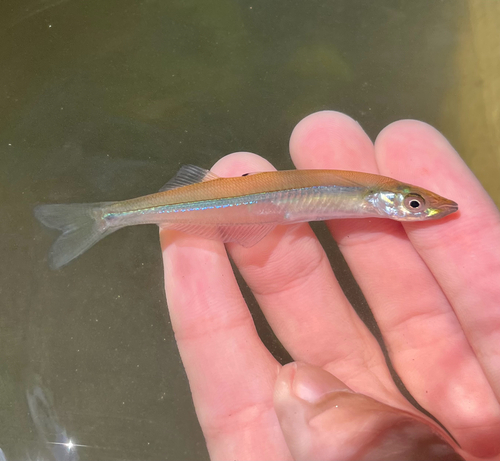
Brook Silverside
Labidesthes sicculus
A shimmering 'glass fish' of the shallows, the Brook Silverside is famous for its acrobatic leaps and translucent beauty. Watch these surface-dwellers skip across your backyard dock or shoreline.
Quick Identification
Size
2.5 to 4.5 inches (6.4 to 11.4 cm); extremely slender and elongated
Colors
Translucent, pale green to yellow-glassy body with a prominent, bright silvery lateral stripe
Key Features
- Long, beak-like upward-turned snout
- Bright silvery band running along the sides
- Translucent 'glass-like' body appearance
- Two widely separated dorsal fins, the first being very small
When You’ll See Them
Geographic range
Where Does the Brook Silverside Live?
Native to the North American continent, the Brook Silverside is a widespread freshwater inhabitant primarily found throughout the Great Lakes basin and the vast Mississippi River drainage. This species thrives in the United States and southern Canada, with its core populations stretching from the clear lakes of Ontario and New York down to the humid Gulf Coastal Plains of Texas and Florida. While mostly resident in their native range, they have occasionally been introduced to new reservoirs outside their historical boundaries via bait bucket releases, though they remain a quintessentially eastern North American species.
Basemap © OpenStreetMap contributors
Behavior
The Brook Silverside is a highly energetic, schooling fish primarily known for its 'skipping' behavior. These fish are surface specialists, spending nearly their entire lives in the top few inches of the water column. When startled or pursuing prey, they frequently leap out of the water, skittering across the surface for several feet. This unique trait has earned them the nickname 'skipjacks' in many regions.
Socially, they are almost never found alone. They form tight-knit schools that move in synchronized bursts, flashing their silver sides as they turn. Interestingly, the Brook Silverside is an annual species, meaning most individuals live only about one year, spawning in their second summer and dying shortly after. They are very sensitive to water quality and will quickly vanish from areas where the water becomes too turbid or murky.
EverydayEarth exclusive
Camera Tips
Capturing the Brook Silverside requires a specialized approach because they occupy the very top of the water column. For the best results, use an underwater action camera or a dedicated aquatic trail cam mounted just 2 to 4 inches below the surface. Using a 'buoy mount' or a stake driven into the shallows near a dock or weed bed is ideal. Position the camera horizontally to capture the silver lateral line, which reflects light beautifully in the morning sun.
Because these fish are highly sensitive to movement, avoid placing your camera in high-traffic swimming areas. Instead, look for 'quiet' corners of a lake or pond where aquatic vegetation like lily pads or pondweed is present. The edges of these plants serve as natural highways for schools of silversides. Setting your camera to record in high frame rates (60fps or 120fps) is a pro tip; these fish move incredibly fast, and slow-motion playback is often the only way to appreciate their 'skipping' leaps or the intricate detail of their translucent bodies.
Lighting is your best friend when filming this species. While you can't easily bait them with traditional food, you can 'bait' them with light at night or during twilight. A small, submersible LED light can attract the microscopic zooplankton that silversides feed on, drawing the school right in front of your lens. During the day, aim for side-lighting—where the sun is at a 45-degree angle to the camera—to make that signature silver stripe really pop against the translucent body.
Similar Species
Species that look similar or are commonly confused with Brook Silverside.
Frequently Asked Questions
Record Brook Silverside at your habitat
Connect a camera to start building your own species record — AI identifies every visitor automatically.