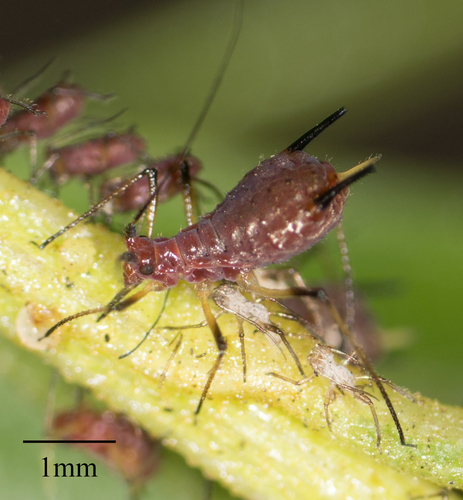
Brown Ambrosia Aphid
Uroleucon ambrosiae
A master of the backyard meadow, the Brown Ambrosia Aphid forms bustling colonies on sunflowers and goldenrod. Watch these tiny, mahogany-colored sap-suckers as they are farmed by ants and evade predators in your own garden.
Quick Identification
Size
2.5–4.0 mm (0.1–0.16 inches) in length
Colors
Deep reddish-brown to dark mahogany body; black siphunculi; pale legs with dark joints
Key Features
- Dark reddish-brown pear-shaped body
- Extremely long antennae, often exceeding body length
- Prominent black siphunculi (tail-pipes) at the rear
- Long, pale legs with black 'knees' and 'socks'
When You’ll See Them
Geographic range
Where Does the Brown Ambrosia Aphid Live?
Native to the vast landscapes of North America, the Brown Ambrosia Aphid is a ubiquitous resident found from the southern reaches of Canada through the United States and into Mexico. Its range extends significantly into Central and South America, following the natural distribution of its preferred host plants. While primarily a New World species, it has been introduced to parts of Europe and Asia, where it continues to expand its footprint within temperate and subtropical climate zones.
Basemap © OpenStreetMap contributors
Behavior
The Brown Ambrosia Aphid is a social sap-sucker that forms dense, pulsating colonies on the stems of composite plants. Unlike many aphid species that hide under leaves to avoid detection, these are remarkably bold, congregating in plain sight along the upper stems and flower buds. They are frequently found in a fascinating symbiotic relationship where ants 'farm' them, offering protection from predators like ladybugs and lacewings in exchange for sugary honeydew secretions.
When threatened by a predator, the colony may exhibit a collective defense behavior, where individuals twitch in unison or drop from the plant simultaneously to escape. They are prolific breeders; during the summer months, females reproduce via parthenogenesis, giving birth to live clones of themselves without the need for mating. This allows their populations to explode overnight when their favorite host plants, such as ragweed or goldenrod, are in their peak growth phase.
EverydayEarth exclusive
Camera Tips
Capturing high-quality footage of the Brown Ambrosia Aphid requires a specialized approach, as their small size makes them invisible to standard trail camera setups. You will need a camera with a dedicated macro lens or a high-resolution smart camera capable of focusing within 2–4 inches of the subject. Position your camera on a tripod specifically targeting the stems of Goldenrod (Solidago) or Ragweed (Ambrosia) during late summer. These aphids prefer the tender, upper sections of the plant, so aim your lens just below the flower clusters.
Because these insects are static but the plants they live on are not, wind is your biggest enemy. Use a garden stake to stabilize the host plant or choose a calm, overcast day for filming to avoid harsh shadows and motion blur. If your camera allows for manual focus, lock it onto the stem where the colony is thickest. For AI-powered cameras, ensure the 'small animal' or 'insect' detection mode is active, as their dark bodies provide excellent contrast against the green or yellow stems of their host plants.
Lighting is critical for bringing out the rich mahogany color of the Uroleucon ambrosiae. A subtle side-light or a ring light can highlight the translucent quality of their bodies and the length of their antennae. If you're looking to capture action, watch for ant activity; ants frequently patrol these colonies, and their interactions provide dynamic movement that is easier for motion-sensing cameras to trigger. Late afternoon is often the best time, as the 'golden hour' light makes their reddish-brown bodies glow against the background.
Similar Species
Species that look similar or are commonly confused with Brown Ambrosia Aphid.
Frequently Asked Questions
Record Brown Ambrosia Aphid at your habitat
Connect a camera to start building your own species record — AI identifies every visitor automatically.