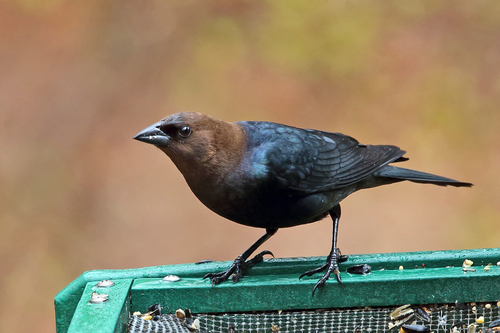
Brown-headed Cowbird
Molothrus ater
North America's most famous 'nest-crashing' nomad, the Brown-headed Cowbird is a master of adaptation. Whether following cattle or visiting your backyard feeder, these social blackbirds are a fascinating study in survival and strategy.
Quick Identification
Size
Length: 19–22 cm (7.5–8.7 in); Wingspan: 32–38 cm (12.5–15 in); Weight: 30–60 g (1–2 oz)
Colors
Males have an iridescent black body with a rich chocolate-brown head; females are a uniform dull grayish-brown with subtle streaking on the belly and a lighter throat.
Key Features
- Thick, conical finch-like bill used for cracking seeds
- Glossy black plumage with a distinct brown head in males
- Slightly smaller than a Red-winged Blackbird with a shorter tail
- Females lack strong markings, appearing as plain grayish-brown birds
When You’ll See Them
Sightings on EverydayEarth
Aug 2, 2026
A busy scene at the feeders with several species present at once. A Mourning Dove feeds calmly in the central tray while a Downy Woodpecker works on the suet feeder to the left. On the right side, multiple male Red-winged Blackbirds and a Brown-headed Cowbird take turns at the tube feeder, with frequent flying and hopping as they compete for space.
Aug 1, 2026
A group of birds is busy at the feeding station. Several male Red-winged Blackbirds land on the ground tray to forage for grain, while a streaked female feeds from a hanging cylinder. On the right, a male Brown-headed Cowbird perches on a tube feeder. The birds are active and vocal, with frequent arrivals and departures.
Aug 1, 2026
The scene is active with several birds visiting the feeder station. A male Downy Woodpecker is initially perched on the center feeder before departing. Shortly after, two Common Grackles land on the main tray to forage. A Brown-headed Cowbird is also seen feeding on the log-style suet feeder on the left, while another grackle perches above the station.
Jul 30, 2026
The feeding station is very active with a variety of species. Several male Red-winged Blackbirds are prominent, showing off their bright epaulets, while streaked females and juveniles forage on the tray. A male Hairy Woodpecker is steadily working on the suet feeder to the left. Common Grackles and Brown-headed Cowbirds cycle through, landing and departing in a flurry of mid-summer activity.
Jul 29, 2026
A male Downy Woodpecker is actively feeding on the leftmost suet feeder. Several Brown-headed Cowbirds are also present, perched on the central log feeder and the tube feeder to the right, with one cowbird departing the tube feeder toward the end of the clip.
Jul 29, 2026
During a steady rain shower, a Tufted Titmouse hops across the main feeder tray. Meanwhile, two Brown-headed Cowbirds land on the hanging tube feeder to the right to feed. A male Red-winged Blackbird briefly flashes into view on the left as it flies past the station.
Geographic range
Where Does the Brown-headed Cowbird Live?
Native to the North American continent, the Brown-headed Cowbird was originally restricted to the open grasslands of the central United States and southern Canada. As forests were cleared for agriculture and suburban development, their range exploded, and they are now found throughout most of the United States and southern Canada, extending down into Mexico during the winter months. They are highly adaptable residents across the southern U.S., while northern populations migrate south when temperatures drop.
Basemap © OpenStreetMap contributors
Recorded on EverydayEarth
Behavior
The Brown-headed Cowbird is most famous (or infamous) for being an obligate brood parasite. This means they do not build their own nests or raise their own young; instead, females stealthily deposit their eggs in the nests of other bird species, leaving the host parents to provide all the care. Because they don't have to spend time nesting, they are highly social and spend much of their day foraging in large, mixed-species flocks with starlings and other blackbirds.
Historically known as 'buffalo birds,' they followed wandering herds of bison across the Great Plains, eating the insects flushed up by the massive grazers. Today, they have adapted perfectly to human presence, often congregating in suburban yards, parks, and agricultural areas. They are bold foragers and show little fear of humans, though they are constantly on the move in search of feeding opportunities or potential host nests during the breeding season.
EverydayEarth exclusive
Camera Tips
To capture the best footage of Brown-headed Cowbirds, position your camera low to the ground, roughly 6 to 12 inches high. These birds are ground-foragers by nature, and they are most likely to spend time walking across your lawn or picking through leaf litter. Aim the camera toward an open patch of grass near a forest edge or a brush pile where they feel secure enough to land before moving into the open.
If you use a bird feeder, switch to a tray or platform-style feeder rather than a tube feeder. Cowbirds have thicker bills and larger bodies than many songbirds, making it difficult for them to use small perches. Scattering cracked corn, white proso millet, or sunflower hearts directly on the ground is a surefire way to trigger your camera's motion sensor as a flock moves through. They are often the first birds to arrive at a fresh spread of seed in the morning.
Because they are highly social, you will often capture them in groups. Set your camera to take short video clips (10-15 seconds) rather than just stills to witness their unique social displays—males will often fluff their feathers, spread their wings, and bow deeply to females or other males while emitting a liquid, 'gurgling' song. These behaviors are most frequent during the spring breeding season from April through June.
Similar Species
Species that look similar or are commonly confused with Brown-headed Cowbird.
Brewer's Blackbird
Brewer's has a longer, thinner bill and bright yellow eyes, whereas the Cowbird has a thick bill and dark eyes.
Common Grackle
Grackles are much larger with much longer, wedge-shaped tails and iridescent purple/blue heads rather than brown.
Shiny Cowbird
Found mostly in Florida and the Caribbean; the male is entirely glossy purple-black without the brown head.
Frequently Asked Questions
Record Brown-headed Cowbird at your habitat
Connect a camera to start building your own species record — AI identifies every visitor automatically.