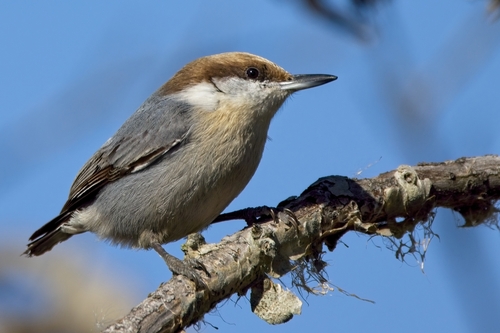
Brown-headed Nuthatch
Sitta pusilla
Meet the 'rubber ducky' of the Southern pines. This tiny, tool-using acrobat is a social marvel of the pine forests, known for its squeaky call and incredible climbing skills.
Quick Identification
Size
Length: 9-11 cm (3.5-4.3 in); Wingspan: 16-18 cm (6.3-7.1 in); Weight: 10-12 g (0.35-0.42 oz)
Colors
Dull brown cap, white spot on the nape, bluish-gray back and wings, and creamy-white underparts; sexes appear identical
Key Features
- Distinctive chocolate-brown cap meeting a dark eye-line
- Small white patch at the base of the neck (nape)
- Short, square tail and long, pointed bill
- Nervous, jerky movements while climbing head-first down tree trunks
When You’ll See Them
Geographic range
Where Does the Brown-headed Nuthatch Live?
Native to the North American continent, the Brown-headed Nuthatch is a quintessential specialist of the Southeastern United States. Its core range stretches from eastern Texas and Oklahoma across the Deep South to the Atlantic coast, reaching as far north as southern Delaware and Maryland. Because they are strictly tied to pine ecosystems, they are rarely found outside this specific regional corridor, though they are quite common within healthy pine savannas and suburban pine groves.
Basemap © OpenStreetMap contributors
Behavior
The Brown-headed Nuthatch is a highly social and energetic songbird, often found in small family groups or mixed-species flocks. They are famous for their unique vocalization, which sounds remarkably like a squeaky rubber ducky. Unlike many other birds, these nuthatches are cooperative breeders, where young males from previous years often stay behind to help their parents raise a new brood, assisting with nest defense and feeding.
One of the most remarkable aspects of their behavior is their documented use of tools. These intelligent birds have been observed using a piece of pine bark as a lever to pry up other scales of bark in search of hidden insects. They are non-migratory and maintain a small home range year-round, making them a consistent and delightful presence for backyard observers in the right habitat.
EverydayEarth exclusive
Camera Tips
To capture high-quality footage of these tiny acrobats, position your camera near mature pine trees. Since they spend most of their time on the trunks and upper branches, a camera mounted at eye-level on a pine tree trunk, facing a suet feeder or a specialized 'nuthatch feeder' (which allows them to feed upside down), is ideal. They are particularly fond of suet cakes containing nuts or insects, and smearing peanut butter directly into the grooves of the bark can keep them in the camera's frame for longer periods.
Because the Brown-headed Nuthatch is a fast-moving bird, use a camera with a high trigger speed and a fast shutter setting to avoid motion blur. If your AI camera supports 'Pre-roll' or high-frequency bursts, enable these features to catch the moment they land or begin their characteristic head-first descent. They are most active in the morning hours, so ensure your camera is positioned to avoid direct morning glare that could wash out the subtle brown and gray tones of their plumage.
Providing a water source can also be a magnet for these birds. A pedestal bird bath or a hanging dripper near pine cover will encourage them to drop down from the canopy. In the winter, they often travel in 'titmouse flocks,' so if your camera alerts you to a Tufted Titmouse or a Carolina Chickadee, keep a close eye on the feed, as a Brown-headed Nuthatch is likely trailing close behind.
Similar Species
Species that look similar or are commonly confused with Brown-headed Nuthatch.
White-breasted Nuthatch
Larger with a black cap (in males) and a completely white face without the brown cap or nape spot.
Red-breasted Nuthatch
Has a prominent black eye-stripe, a white eyebrow, and rusty-orange underparts.
Pygmy Nuthatch
Visually almost identical but found only in the Western United States, with no range overlap.
Frequently Asked Questions
Record Brown-headed Nuthatch at your habitat
Connect a camera to start building your own species record — AI identifies every visitor automatically.