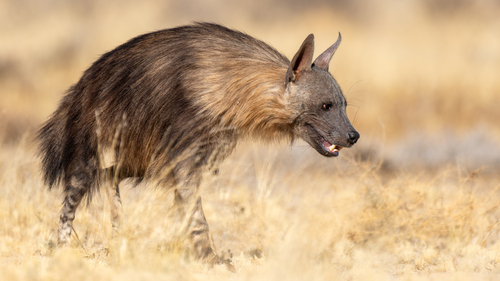
Brown Hyaena
Parahyaena brunnea
Meet the 'strandwolf' of the desert, a shaggy, solitary wanderer with a secret social life. As the rarest hyaena species, the Brown Hyaena is a master of survival in Africa's harshest landscapes.
Quick Identification
Size
Length: 110-136 cm (43-54 in); Weight: 35-50 kg (77-110 lb)
Colors
Dark brown to blackish shaggy coat; greyish head; horizontal white and black stripes on the legs
Key Features
- Long shaggy dark brown mane covering the back and sides
- Pointed, oversized ears for heat regulation and hearing
- Sloping back profile with hindquarters lower than shoulders
- Distinctive grey and black striped 'stocking' legs
When You’ll See Them
Geographic range
Where Does the Brown Hyaena Live?
The Brown Hyaena is a resident of the arid regions of Southern Africa, with its heartland centered in the vast Kalahari Desert and the coastal fringes of the Namib. While its core populations are found across Namibia and Botswana, this resilient mammal also roams throughout South Africa, western Zimbabwe, and southern Mozambique. Unlike many other large carnivores, they have managed to persist in some farm-dominated landscapes and the outskirts of rural towns, though they are most frequently encountered in protected wilderness areas and along the desolate Skeleton Coast.
Basemap © OpenStreetMap contributors
Behavior
Brown Hyaenas are primarily solitary foragers, spending their nights wandering vast distances—sometimes up to 30 kilometers—in search of food. Despite their loner lifestyle when hunting, they are social animals that live in small, loose-knit clans organized around a communal den. These clans defend a shared territory but rarely interact during their nightly rounds, typically only meeting to share information or assist in raising the clan's cubs.
Compared to the more vocal Spotted Hyaena, the Brown Hyaena is much more timid and avoids confrontation. They rely on a highly developed sense of smell to locate carcasses from kilometers away. While they are generally shy of humans, they are remarkably persistent and can survive in harsh environments where other large carnivores would perish. They communicate using scent marking and various postures, including raising their long mane to appear larger when threatened.
EverydayEarth exclusive
Camera Tips
To capture the elusive Brown Hyaena, position your camera along established game trails, dry riverbeds, or fence lines where these solitary scavengers frequently patrol. Since they are strictly nocturnal, ensure your camera has a high-quality infrared flash that provides clear black-and-white images without spooking them with a white light. Mounting the camera lower to the ground—about 18 to 24 inches high—will provide an intimate, 'eye-to-eye' perspective that highlights their iconic shaggy mane and striped legs.
Scent is the most effective way to draw a Brown Hyaena into your frame. Commercial carnivore lures, or even a bit of pungent fish oil placed on a nearby rock or log, can encourage them to linger and investigate. Because they are highly intelligent and cautious, avoid checking the camera too frequently; human scent left behind can deter them for several days. If you are operating a camera in a coastal region, look for 'latrines'—areas with white, calcified droppings—as these are regularly visited by clan members for scent marking.
Set your camera to take bursts of 3-5 photos or short video clips of 15-20 seconds with a minimal trigger delay. Brown Hyaenas often stop to sniff and 'paste' (scent mark) their surroundings, and video is particularly effective at capturing their unique, sloping gait and the way they raise their long back hair when curious. During the dry season, placing cameras near isolated water holes is almost a guaranteed way to see them, as they must travel long distances to drink under the cover of darkness.
Similar Species
Species that look similar or are commonly confused with Brown Hyaena.
Frequently Asked Questions
Record Brown Hyaena at your habitat
Connect a camera to start building your own species record — AI identifies every visitor automatically.