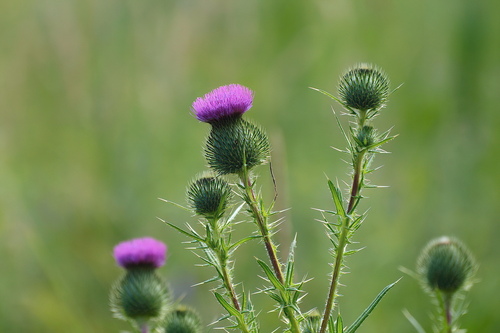
Bull Thistle
Cirsium vulgare
The Bull Thistle is a rugged and beautiful survivor, famous as the national emblem of Scotland and beloved by backyard pollinators for its nectar-rich purple blooms.
Quick Identification
Size
Stands 1 to 1.5 meters (3 to 5 feet) tall, occasionally reaching 2.5 meters (8 feet) in ideal conditions.
Colors
Deep purple to pink flower heads; dull grey-green leaves with light green undersides and yellow-tipped spines.
Key Features
- Spiny 'winged' stems that are prickly to the touch
- Large, bulbous flower heads (1-2 inches) with a pincushion appearance
- Deeply lobed, lance-shaped leaves with stiff hairs and sharp prickles on the surface
When You’ll See Them
Geographic range
Where Does the Bull Thistle Live?
Native across Europe, Western Asia, and Northwest Africa, the Bull Thistle has successfully naturalized on nearly every continent. In North America, it is found from the southern reaches of Canada down through the entire continental United States and into Mexico. It thrives in temperate regions and is frequently seen in disturbed soils where human activity or grazing has cleared competing vegetation.
Basemap © OpenStreetMap contributors
Behavior
Bull Thistle is a biennial plant, meaning it spends its first year as a low-growing rosette of prickly leaves. During this phase, it focuses on developing a thick taproot to store energy. In its second year, it rapidly sends up a tall, branched flowering stalk, often appearing in mid-summer. This vertical growth is an evolutionary strategy to ensure its seeds can be caught by the wind and dispersed over long distances.
While many gardeners treat it as a nuisance weed, it is a powerhouse for local biodiversity. The nectar-rich flowers are high-priority targets for long-tongued bees, butterflies, and hummingbirds. Unlike some other thistles, the Bull Thistle is a 'social' plant for insects, often hosting multiple species at once on its large, accessible flower heads.
As the flowers fade, they produce a white, fluffy down called 'pappus' attached to the seeds. This material is highly prized by birds, particularly American Goldfinches, who use the fluff to line their nests and rely on the oil-rich seeds as a primary food source for their late-season broods.
EverydayEarth exclusive
Camera Tips
To capture the stunning architecture of a Bull Thistle, position your camera at a low angle, looking slightly up toward the flower head. This 'worm's eye view' emphasizes the plant's height and makes the purple bloom stand out against the sky. Because the plant is stationary, use a macro setting or a lens with a shallow depth of field to blur the background, making the intricate geometric patterns of the spiny bracts really pop.
If you are using a motion-activated camera to capture wildlife visiting the thistle, set the trigger sensitivity to high. Thistles are a hub for pollinators like Swallowtail butterflies and Clearwing moths. Aim your camera at the flower head from a distance of about 2 to 3 feet to ensure the insect and the flower remain in focus. Fast shutter speeds are essential here, as pollinators move quickly and unexpectedly.
Late summer is the best time for trail camera placement near thistles to capture bird activity. American Goldfinches are famous for clinging to the drying flower heads to extract seeds. Position your camera facing north or south to avoid lens flare from the sun, and look for a plant that is just beginning to turn 'fluffy.' This is the peak window for avian visitors.
Don't overlook the early morning hours for photography. Bull Thistle leaves and spines are excellent at catching dew and spider webs. If your camera has a time-lapse mode, setting it to take a photo every 15 minutes during a warm July day can reveal the fascinating way the flower head opens and how the 'winged' stems track the light. Ensure your camera is securely mounted to a stake, as the plant can sway significantly in the wind.
Similar Species
Species that look similar or are commonly confused with Bull Thistle.
Frequently Asked Questions
Record Bull Thistle at your habitat
Connect a camera to start building your own species record — AI identifies every visitor automatically.