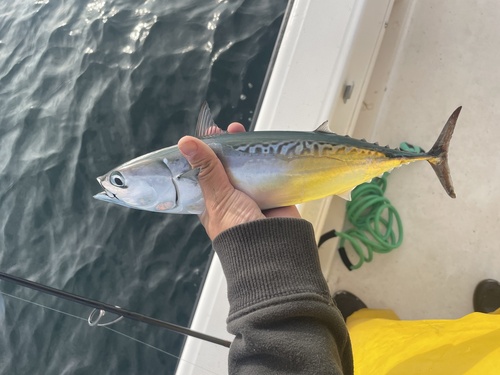
Bullet Tuna
Auxis rochei
The Bullet Tuna is the ocean's silver speedster, a streamlined marvel that never stops moving. Found in warm seas across the globe, these miniature powerhouses represent the raw energy of the open blue.
Quick Identification
Size
Maximum length of 50 cm (20 in); typical weight range of 1.5–2 kg (3.3–4.4 lbs)
Colors
Metallic blue-black to dark purple on the back, transitioning to a shimmering silvery-white belly; distinct dark, wavy vertical bars on the upper rear body
Key Features
- Torpedo-shaped, streamlined body
- Two widely separated dorsal fins
- 15 or more dark, nearly vertical bars above the lateral line
- Very short pectoral fins that do not reach the vertical bars
- Large scales limited to the 'corselet' area around the front of the body
When You’ll See Them
Geographic range
Where Does the Bullet Tuna Live?
The Bullet Tuna is a truly global citizen of the sea, inhabiting the warm tropical and subtropical waters of the Atlantic, Indian, and Pacific Oceans. In the Western Atlantic, they are commonly found from Southern New England down to Brazil, while in the east, they are a staple species throughout the Mediterranean and Black Seas. Their range extends across the Indo-Pacific from South Africa to the Hawaiian Islands, thriving wherever water temperatures remain consistently warm.
Basemap © OpenStreetMap contributors
Behavior
The Bullet Tuna is a high-energy pelagic species that lives its life in a state of perpetual motion. As ram-ventilators, these fish must swim constantly to force oxygen-rich water over their gills, making them one of the most active predators in the ocean's surface layer. They are highly social and form massive, fast-moving schools that can contain thousands of individuals, often mixing with other small tunas like the Frigate Tuna.
Their behavior is largely driven by water temperature and the movement of prey. They are known for their incredible bursts of speed when hunting or escaping predators like marlin and sharks. While they generally prefer the open ocean, they are known to make seasonal migrations into coastal waters when the sea surface temperature rises, bringing them within sight of shorelines and piers.
EverydayEarth exclusive
Camera Tips
Capturing the Bullet Tuna on camera requires a specialized approach since they inhabit the underwater world. If you are using an action camera like a GoPro near a coastal area or from a boat, set your resolution to at least 4K at 60 frames per second. These fish move incredibly fast, and a high frame rate is essential to capture a clear image without motion blur as they zip through the frame.
For the best lighting, submerge your camera during high noon when the sun is directly overhead. This allows the light to penetrate the water column, reflecting off the tuna's metallic scales and highlighting the unique wavy bars on their back. If you are filming in deeper or greener water, consider using a magenta or red filter to bring back the natural silver and blue tones that get lost in the underwater spectrum.
To bring Bullet Tuna within range of a stationary camera, such as one mounted on a pier or a buoy, use 'flashers' or shiny reflective lures suspended in the current. The tuna are attracted to the glint of silver, which mimics a school of baitfish. Baiting the area with small pieces of oily fish like sardines can also create a 'feeding frenzy' that will keep the school in front of your lens for a longer duration.
If you are using a trail camera in an underwater housing, look for areas with 'upwellings' where nutrient-rich water comes to the surface, as these are natural magnets for the plankton and small fish that Bullet Tuna hunt. Position the camera horizontally to the surface, as these fish almost always travel in the top 10 meters of the water. Avoid pointing the camera directly at the sun to prevent lens flare on the water's surface.
Similar Species
Species that look similar or are commonly confused with Bullet Tuna.
Frigate Tuna
Very similar but has a much narrower band of scales along the lateral line and slightly longer pectoral fins.
Skipjack Tuna
Grows much larger and features dark horizontal stripes on the belly rather than vertical bars on the back.
Little Tunny
Possesses dark, fingerprint-like spots between the pectoral and pelvic fins, which are absent on the Bullet Tuna.
Frequently Asked Questions
Record Bullet Tuna at your habitat
Connect a camera to start building your own species record — AI identifies every visitor automatically.