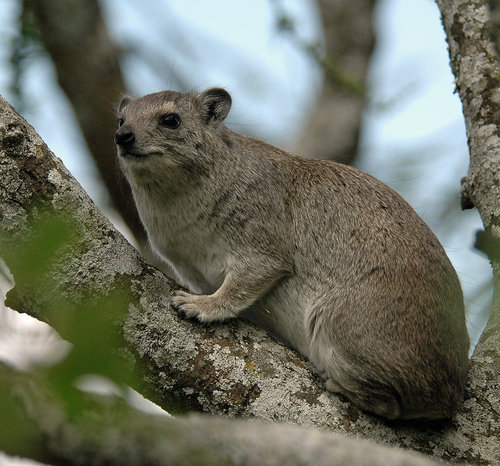
Bush Hyrax
Heterohyrax brucei
The Bush Hyrax is a master of the African kopje, an agile climber that shares a surprising evolutionary link with the elephant. These social mammals are best seen basking on sun-drenched boulders across the savannas of East and Southern Africa.
Quick Identification
Size
Length 32-56 cm (13-22 in); weight 1.3-4.5 kg (2.9-9.9 lb)
Colors
Brownish-grey or grizzled coat; creamy white underparts; distinctive white or yellow spot on the mid-back covering a scent gland
Key Features
- Prominent white or pale yellow patch on the back
- Short, rounded ears and a pointed, rodent-like snout
- Specialized rubbery pads on feet for climbing rocks
- Lack of a visible tail
When You’ll See Them
Geographic range
Where Does the Bush Hyrax Live?
Native to the African continent, the Bush Hyrax occupies a vast territory stretching from Northeast Africa down through the southern regions. Its core range includes the rocky landscapes of Ethiopia, Kenya, and Tanzania, extending through the savanna belts of Zambia, Zimbabwe, and Mozambique into northern South Africa. These animals are strictly tied to specific geological features, meaning their distribution is patchy and follows the presence of rocky 'islands' or kopjes across the African plains.
Basemap © OpenStreetMap contributors
Behavior
The Bush Hyrax is a highly social mammal that lives in large, noisy colonies often numbering dozens of individuals. These colonies are structured around a dominant male who defends a harem of females and their offspring. Despite their chunky, marmot-like appearance, they are incredibly agile climbers, using specialized moist pads on their feet to create suction against sheer rock faces. They spend a significant portion of their morning and late afternoon basking in the sun to regulate their body temperature, as they have a relatively poor internal thermoregulation system.
Interestingly, Bush Hyraxes are frequently found living in close proximity—and even sharing sleeping quarters—with Rock Hyraxes (Procavia capensis). While they share habitats, they avoid direct competition for food; the Bush Hyrax is a browser that eats leaves and twigs, while its cousin is a grazer that prefers grass. They are very vocal animals, using a series of twitters, whistles, and harsh screams to communicate within the colony or warn of approaching predators like eagles or leopards.
EverydayEarth exclusive
Camera Tips
To capture high-quality footage of a Bush Hyrax, look for 'kopjes' or large piles of boulders with visible white stains. These white patches are communal latrines where the animals' urine (rich in calcium carbonate) crystallizes over generations; they are absolute magnets for hyrax activity. Place your camera at ground level, roughly 6 to 12 inches high, facing these latrine areas or the flat 'basking rocks' where the colony congregates in the morning sun.
Because these animals are most active during the peak sunlight hours for basking, your camera may struggle with harsh shadows on light-colored rocks. Position your camera so the sun is behind it to avoid silhouetting your subjects. A high-speed trigger is essential, as hyraxes can move with surprising speed when darting between crevices. If your camera supports burst mode, use it to capture their social interactions, such as huddling or grooming.
Hyraxes are naturally wary of new objects in their environment. If you are placing a camera near a known den or crevice, camouflage it with local vegetation or stones to prevent the colony from avoiding the area. Since they are browsers, you don't necessarily need bait, but placing the camera near an acacia bush or a fruiting tree growing out of the rocks can provide excellent 'action' shots of them feeding on their hind legs.
Similar Species
Species that look similar or are commonly confused with Bush Hyrax.
Frequently Asked Questions
Record Bush Hyrax at your habitat
Connect a camera to start building your own species record — AI identifies every visitor automatically.