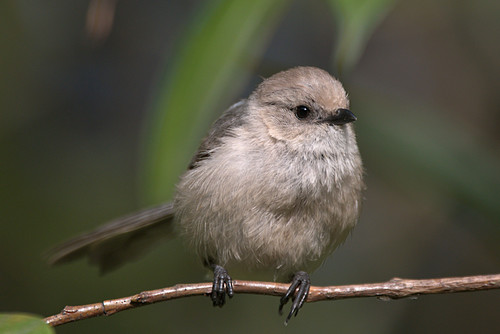
Bushtit
Psaltriparus minimus
The Bushtit is the tiny social butterfly of the avian world, traveling in 'brigades' of dozens. Watch closely and you'll see these acrobatic birds hanging upside down in search of a snack.
Quick Identification
Size
Length 7–11 cm (2.8–4.3 in); Wingspan 15 cm (6 in); Weight 5–6 g (0.18–0.21 oz)
Colors
Drab grayish-brown overall with slightly paler underparts and a brown crown. Adult males have dark irises, while adult females have distinct pale yellow or white eyes.
Key Features
- Smallest songbird in the American West with a disproportionately long tail
- Uniform grayish-brown plumage with no wing bars or eye rings
- Adult females have distinctive pale yellow eyes
- Hyper-social behavior, almost always seen in groups of 10-40
When You’ll See Them
Geographic range
Where Does the Bushtit Live?
Native to the western half of North America, the Bushtit is a permanent resident from the southern tip of British Columbia through the Pacific Coast and Intermountain West, extending deep into the highlands of Central Mexico. While they are strictly a western species, their range is expansive within that territory, covering everything from coastal scrub to high-altitude mountain forests. They do not migrate, making them a reliable year-round delight for birdwatchers across the American West and Mexico.
Basemap © OpenStreetMap contributors
Behavior
The Bushtit is one of the most social birds in North America, rarely seen alone. They move through neighborhoods in restless, talkative flocks known as 'bushtit brigades.' These groups flit rapidly from branch to branch, maintaining contact with constant high-pitched chips and whistles. Their foraging style is acrobatic; they often hang upside down from the tips of branches to glean tiny insects from the undersides of leaves.
During the breeding season, they construct one of the most elaborate nests in the bird world—a pendulous, sock-like pouch made of spider webs, moss, and lichen that can hang up to a foot long. Interestingly, Bushtits often exhibit cooperative breeding, where 'helpers' (usually related males) assist the primary pair in feeding and defending the nestlings. This communal spirit extends to nighttime, where flocks will huddle together on a single branch to conserve heat during cold winter nights.
EverydayEarth exclusive
Camera Tips
To capture high-quality footage of Bushtits, speed is your best friend. Because these birds are tiny and move frantically, a camera with a fast trigger speed and 'Burst Mode' is essential. If your AI camera supports video, set it to record short 10-15 second clips; a single photo often misses the 'brigade' as they zip through the frame. Position your camera near dense, twiggy shrubs or evergreen trees like oaks or junipers where they naturally forage.
The most effective lure for a Bushtit is a suet feeder. They are particularly fond of high-fat suet during the winter months. Place your camera 3 to 5 feet away from a suet cage to capture the social dynamics of the flock, as half a dozen birds will often pile onto the feeder at once. Because they are so small, a close-up focal length is required to see their unique eye colors—the pale yellow of the female and the dark eye of the male.
Water is another fantastic way to bring them into the camera's view. Bushtits are famous for communal bathing; if you have a birdbath with a solar fountain or dripper, aim your camera there. Seeing ten or fifteen Bushtits splashing together is one of the most rewarding sights for a backyard explorer. Ensure the camera is positioned to avoid direct morning sun, which can wash out their subtle gray-brown colors, aiming instead for soft, indirect light.
Similar Species
Species that look similar or are commonly confused with Bushtit.
Black-capped Chickadee
Chickadees have a distinct black cap and throat bib, whereas Bushtits are uniformly gray-brown.
Ruby-crowned Kinglet
Kinglets have a prominent white eye-ring and flick their wings constantly, which Bushtits do not do.
Verdin
Found in desert regions, Verdins have a yellow head and a chestnut shoulder patch, unlike the plain gray Bushtit.
Frequently Asked Questions
Record Bushtit at your habitat
Connect a camera to start building your own species record — AI identifies every visitor automatically.