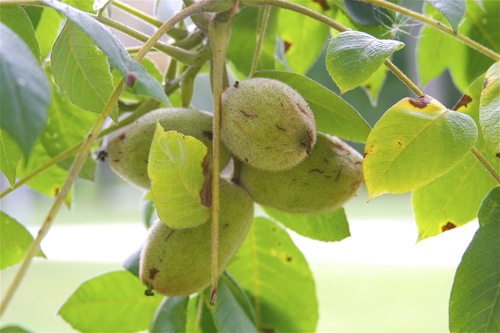
Butternut
Juglans cinerea
A rare gem of the North American forest, the Butternut is beloved for its rich, buttery nuts and distinctive silvery bark. Though currently facing a fight for survival, it remains a vital hub for backyard wildlife.
Quick Identification
Size
Height 20-30 m (65-100 ft); trunk diameter 40-80 cm (16-32 in)
Colors
Silvery-gray bark, yellowish-green leaves, and brown, sticky husks on the nuts.
Key Features
- Chocolate-brown chambered pith inside twigs
- Sticky, fuzzy, elongated fruit husks
- Large fringe of light-colored hair above the leaf scar
- 11-17 leaflets with a terminal leaflet
When You’ll See Them
Geographic range
Where Does the Butternut Live?
Native to the temperate regions of eastern North America, the Butternut is found from southern Quebec and New Brunswick down through the New England states. Its core range extends westward to Minnesota and south through the Appalachian Mountains into northern Georgia and Arkansas. While it was once common throughout the eastern United States and southeastern Canada, it is now increasingly rare in the wild due to the spread of butternut canker.
Basemap © OpenStreetMap contributors
Behavior
The Butternut, also known as the White Walnut, is a relatively short-lived deciduous tree compared to its cousin, the Black Walnut. It is a shade-intolerant species, meaning it requires full sunlight to grow and often establishes itself as a pioneer species in forest clearings, along stream banks, and at the edges of woodlands. It grows quickly when young but rarely lives beyond 75 years, especially now that it faces pressure from disease.
Ecologically, the Butternut acts as a vital food reservoir. Its nuts have a significantly higher fat content than most other North American nuts, making them a prized resource for wildlife preparing for winter. While it produces a chemical called juglone that can inhibit the growth of some surrounding plants, it is less toxic than the Black Walnut, allowing a more diverse understory to thrive beneath its canopy.
EverydayEarth exclusive
Camera Tips
To capture the best activity around a Butternut, position your camera 3 to 5 feet off the ground on a sturdy post or an adjacent tree, aimed toward the base of the Butternut's trunk. The primary draw for wildlife is the nut crop, so focus your lens on the ground where the heavy, sticky nuts fall. Use a high-resolution setting to capture the unique 'fuzzy' texture of the husks, which distinguishes them from other walnuts.
Because Butternuts attract highly active foragers like Gray Squirrels, Flying Squirrels, and Blue Jays, set your camera to 'Burst Mode' or short 10-second video clips. These animals often move in quick, jerky motions as they gather and cache the nuts. Late September through October is the golden window for activity; during this time, the high-fat nuts are a magnet for local mammals bulking up for the cold months.
If you are interested in the tree's health, use your camera to take periodic high-resolution stills of the trunk. Look for the 'diamond-shaped' bark patterns or signs of the butternut canker, such as black sooty patches or sinking wounds. Setting your camera to trigger during early morning light will provide the best contrast for the silvery bark, making identification and health monitoring much easier.
Similar Species
Species that look similar or are commonly confused with Butternut.
Frequently Asked Questions
Record Butternut at your habitat
Connect a camera to start building your own species record — AI identifies every visitor automatically.