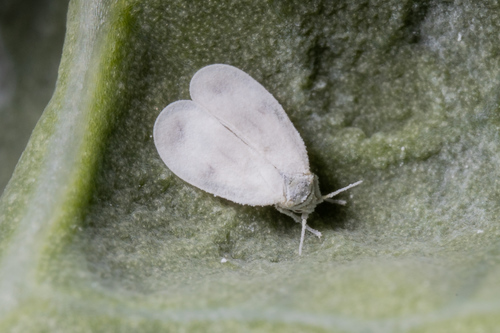
Cabbage Whitefly
Aleyrodes proletella
The Cabbage Whitefly is the snowy ghost of the vegetable patch. Though tiny, these resilient insects can turn a single kale leaf into a bustling, waxy metropolis of activity.
Quick Identification
Size
Adults are approximately 1.5 mm (0.06 inches) in length with a wingspan of roughly 3 mm (0.12 inches).
Colors
Powdery white wings and body; adults are distinguished by two faint, dark gray or blackish spots on each forewing.
Key Features
- Tiny, moth-like appearance with white waxy wings
- Two distinctive dark spots on each forewing
- Usually found in large colonies on the undersides of leaves
- Adults take flight in a white 'cloud' when disturbed
When You’ll See Them
Geographic range
Where Does the Cabbage Whitefly Live?
The Cabbage Whitefly is primarily native to Europe, where it is a common and widespread resident of both agricultural and suburban landscapes. Over the decades, it has expanded its range through the global transport of produce and is now frequently found across parts of Asia, North Africa, and occasionally in North and South America. It thrives in temperate climates wherever its preferred host crops are cultivated, making it a familiar sight for gardeners across the Northern Hemisphere.
Basemap © OpenStreetMap contributors
Behavior
Cabbage Whiteflies are highly social insects that spend nearly their entire lives on the undersides of host plant leaves. They are sap-suckers, utilizing a specialized rostrum to pierce plant tissue and feed on the nutrient-rich phloem. While individual whiteflies are tiny, they often congregate in massive colonies, covering the leaf surface with a layer of white, waxy powder and sticky honeydew. This honeydew often encourages the growth of sooty molds, which can further stress the host plant.
Unlike many other whitefly species that require the warmth of a greenhouse, the Cabbage Whitefly is exceptionally hardy. They are capable of surviving frosts and remain active much later into the autumn than their tropical relatives. When the host plant is brushed or shaken, the entire colony will take flight simultaneously, creating a brief, shimmering cloud of white before the insects quickly settle back onto the foliage to resume feeding.
EverydayEarth exclusive
Camera Tips
Capturing the Cabbage Whitefly requires a camera with excellent macro capabilities, as these insects are smaller than a grain of rice. Because they live almost exclusively on the undersides of leaves, you should position your camera low to the ground, facing upward toward the bottom of kale or cabbage leaves. A fixed mount or a very stable tripod is essential; even the slightest breeze moving the leaf will cause a macro shot to lose focus.
Lighting is the most critical factor for success. The underside of a large cabbage leaf is naturally shaded, so use a diffused LED light source or a ring light to illuminate the colony. Be careful with high-intensity flashes, as the white waxy powder on their wings is highly reflective and can easily result in overexposed, 'blown-out' images. Aim for soft, even light to reveal the subtle dark spots on their wings and the texture of their waxy secretions.
To capture the iconic 'white cloud' behavior, set your camera to a high-speed burst mode and a fast shutter speed (at least 1/1000s). You can trigger this behavior by gently tapping the host plant. For AI-powered backyard cameras, ensure the device is placed within its minimum focal distance—usually just a few inches from the leaf surface—to get clear identification. Late summer and early autumn are the best times to record high activity levels, as populations peak during this period.
Similar Species
Species that look similar or are commonly confused with Cabbage Whitefly.
Frequently Asked Questions
Record Cabbage Whitefly at your habitat
Connect a camera to start building your own species record — AI identifies every visitor automatically.