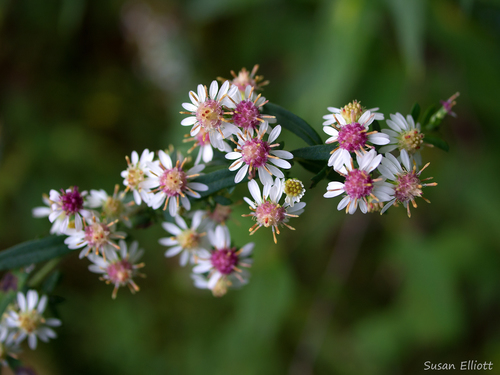
calico aster
Symphyotrichum lateriflorum
A late-blooming pollinator magnet, the calico aster is famous for its 'lateriflorum' growth—clusters of white flowers that line one side of its branches. Its shifting colors provide a spectacular autumn show for both humans and backyard wildlife.
Quick Identification
Size
Height: 30–120 cm (12–47 in); Width: 15–30 cm (6–12 in)
Colors
White ray florets; central disk flowers transition from yellow to reddish-purple or brown; green to burgundy stems.
Key Features
- Tiny white flowers arranged primarily along one side of the branches
- Central flower disks that change color from yellow to purple
- Lance-shaped leaves with hairy midribs on the underside
- Bushy, multi-branched growth habit
When You’ll See Them
Geographic range
Where Does the calico aster Live?
Native to the vibrant ecosystems of North America, the calico aster is a widespread beauty across the eastern and central regions of the continent. Its territory stretches from the Atlantic coast of Canada and the United States westward toward the Great Plains, reaching as far as Texas and the Dakotas. Within this range, it thrives in a variety of light conditions, making it a common sight in both sun-drenched meadows and the dappled shade of deciduous woodlands.
Basemap © OpenStreetMap contributors
Behavior
The calico aster is a late-season powerhouse in the backyard ecosystem. Unlike many spring flowers that fade by mid-summer, this perennial waits until late August or September to burst into bloom. Its most fascinating 'behavior' is the color change of its central disks. Initially yellow, these centers turn to a deep reddish-purple after pollination, signaling to insects which flowers still have nectar and which have already been visited. This creates the 'calico' or multicolored effect that gives the plant its name.
In the wild and in gardens, it serves as a critical bridge for pollinators. As a herbaceous perennial, it dies back to the ground in winter, but its sturdy stems often remain standing, providing hollow cavities for overwintering insects. It is a social plant in the sense that it often grows in clusters, creating a dense nectar station that attracts a wide variety of native bees, wasps, and migrating butterflies like the Monarch.
EverydayEarth exclusive
Camera Tips
To capture the beauty of calico aster, place your camera on a tripod or mount it to a nearby fence post approximately 2 to 3 feet off the ground. Because the flowers are relatively small, you will want to ensure your camera is positioned quite close to the blooms—about 12 to 24 inches—to capture the intricate details of the yellow and purple centers. If your AI camera has a macro or close-up focus mode, be sure to enable it.
The real magic of the calico aster is the wildlife it attracts. To capture visiting pollinators, set your camera to 'Burst' mode or high-frequency trigger settings. Early afternoon is the best time for this, as the sun warms the nectar and insect activity reaches its peak. If you are using a camera with motion detection, be aware that wind can cause the aster's thin branches to sway, which might lead to many 'empty' triggers; try to shield the plant from wind or adjust sensitivity settings accordingly.
For the best aesthetic results, aim your camera toward the west during the late afternoon. The 'Golden Hour' light will catch the white petals and make them glow against the darker forest or garden background. This species is also a great candidate for time-lapse photography; setting your camera to take one photo every 30 minutes over a week in September will beautifully document the transition of the flower centers from yellow to purple.
Similar Species
Species that look similar or are commonly confused with calico aster.
Frequently Asked Questions
Record calico aster at your habitat
Connect a camera to start building your own species record — AI identifies every visitor automatically.