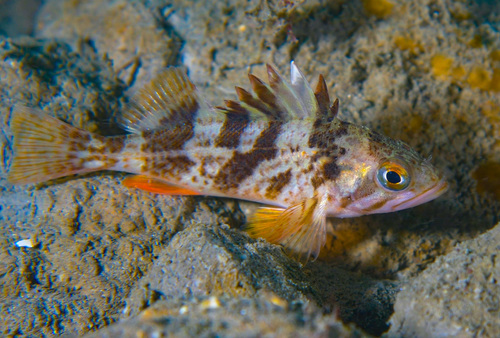
Calico Rockfish
Sebastes dallii
A master of cryptic camouflage, the Calico Rockfish dances through the shadows of California's kelp forests. This small but striking resident is a cornerstone of the Pacific's vibrant underwater reefs.
Quick Identification
Size
A small rockfish reaching 15–20 cm (6–8 inches) in length and weighing up to 0.5 kg (1.1 lbs).
Colors
Yellow-brown to greenish-yellow base with 4–5 prominent dark brown diagonal bars across the flanks and dusky spots on the fins.
Key Features
- Small, slender rockfish profile
- Four to five dark diagonal bands across the body
- Prominent spines on the dorsal fin
- Large, dark eyes suited for low-light reef environments
When You’ll See Them
Geographic range
Where Does the Calico Rockfish Live?
The Calico Rockfish is native to the Eastern Central Pacific Ocean along the temperate coast of North America. Its primary range extends from the waters near San Francisco, California, southward through the Southern California Bight and along the Pacific coast of Baja California, Mexico. This species is a true specialist of the continental shelf, remaining concentrated in these nutrient-rich coastal corridors rather than venturing into the open deep ocean.
Basemap © OpenStreetMap contributors
Behavior
The Calico Rockfish is a relatively social and non-territorial species compared to its larger cousins. They are often observed hovering in small, loose aggregations just above the seafloor or tucked within the protective canopy of kelp forests. During the day, they are active foragers, using their mottled patterns to remain nearly invisible against the complex shadows of rocky reefs. While they are generally wary of large predators, they exhibit a calm curiosity toward stationary observers and underwater equipment.
These fish are ovoviviparous, meaning they practice internal fertilization and females give birth to live, swimming larvae. This reproductive strategy helps protect the young during their most vulnerable stage. Once they settle into their adult habitat, they tend to stay within a small home range for the duration of their lives, which can span over 12 years. They play a vital role in the marine food web as both a predator of small invertebrates and a prey source for larger fish and marine mammals.
EverydayEarth exclusive
Camera Tips
Capturing the Calico Rockfish requires an underwater camera setup positioned near rocky relief or the edges of kelp beds. Because these fish are benthic-oriented, place your camera housing within 1 to 2 meters of the seafloor, ideally at a depth between 20 and 40 meters where light penetration is still sufficient for AI detection. An angle that captures both the rocky structure and a bit of the open water column will increase your chances of filming them as they hover and hunt.
Lighting is the biggest challenge when photographing the Calico Rockfish. At their preferred depths, red and orange light frequencies are filtered out by the water, making the fish appear dull and grey. Use high-CRI (Color Rendering Index) underwater video lights to bring out the rich brown and yellow-green 'calico' patterns. Positioning lights at a 45-degree angle away from the lens will help minimize 'backscatter' caused by suspended particles in the water.
For the best AI identification results, set your camera to trigger on movement with a high frame rate. Calico Rockfish often make sudden, darting movements to grab prey, and a faster shutter speed or higher frame rate (60fps+) will prevent motion blur. If you are in a legal area for attractants, a small perforated container of fish oil or crushed bait can draw them into the frame, but they are naturally curious and will often investigate a camera simply because it provides a new 'structure' in their environment.
Similar Species
Species that look similar or are commonly confused with Calico Rockfish.
Frequently Asked Questions
Record Calico Rockfish at your habitat
Connect a camera to start building your own species record — AI identifies every visitor automatically.