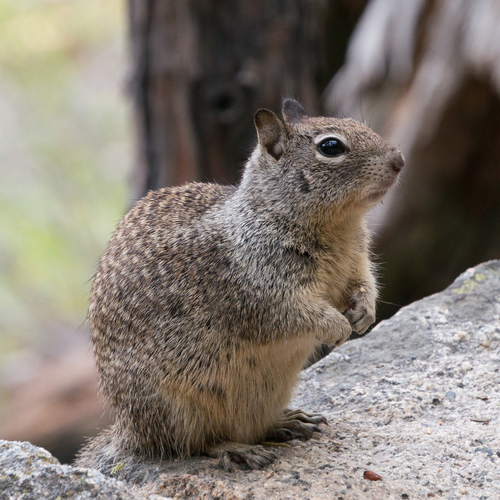
California Ground Squirrel
Otospermophilus beecheyi
The California Ground Squirrel is the West's most famous burrower, known for its complex social lives and incredible 'snake-fighting' abilities. A common sight in backyards and parks, these intelligent rodents offer endless entertainment for wildlife watchers.
Quick Identification
Size
Total length of 30–48 cm (12–19 in) with a tail of 13–21 cm; weight ranges from 280–730 g (10–26 oz)
Colors
Mottled fur with a mix of gray, light brown, and dusky hairs; distinctive lighter gray 'cape' over the shoulders and neck; white rings around the eyes
Key Features
- Speckled grayish-brown mottled fur
- Distinct white ring around each eye
- Light gray fur forming a 'cape' or mantle across the shoulders
- Bushy tail that is shorter and less voluminous than a tree squirrel's
- Small, rounded ears set low on the head
When You’ll See Them
Sightings on EverydayEarth
Jul 22, 2026
A group of California Condors is gathered around a carcass in a dry, grassy field. Several birds are actively feeding, while others stand nearby. Individual birds are visible with numbered wing tags used for population monitoring. In the background, a ground squirrel moves across the hillside near a wooden structure.
Geographic range
Where Does the California Ground Squirrel Live?
Native to the western edge of North America, the California Ground Squirrel is a quintessential resident of the Pacific coast. Its core range spans the entirety of California and extends northward into western Oregon and Washington, with additional populations reaching into northwestern Nevada and the Baja California Peninsula. This adaptable rodent thrives in Mediterranean climates and is frequently found transitioning between wild coastal scrub and human-altered suburban landscapes.
Basemap © OpenStreetMap contributors
Behavior
California Ground Squirrels are highly social and colonial animals, often living in complex burrow systems that they excavate themselves. Unlike their tree-dwelling cousins, they spend nearly all their time on the ground or just beneath it. They are famous for their 'sentinel' behavior, where one individual stands upright on its hind legs to scan for predators like hawks or coyotes, letting out a sharp, bird-like chirp to warn the rest of the colony of danger.
These squirrels have developed fascinating survival tactics, particularly regarding rattlesnakes. They are known to chew on shed snakeskins and lick their fur to mask their scent, and adults have a high resistance to rattlesnake venom. In a display of 'tail-flagging,' they will vigorously wave their tails at snakes, even heating up their tails through blood flow to confuse the heat-sensing pits of the predator. While they can be bold around humans in parks, they remain wary and quick to retreat to their burrows when startled.
EverydayEarth exclusive
Camera Tips
To capture high-quality footage of California Ground Squirrels, place your camera low to the ground, ideally 6 to 12 inches high. Aim the lens toward a known burrow entrance or a flat-topped rock, which these squirrels frequently use as 'lookout' posts. Because they are strictly diurnal, you don't need a heavy-duty infrared flash, but positioning the camera with the sun at its back will prevent washed-out images during their peak morning and afternoon activity hours.
Since these animals are social, you can often capture multiple individuals in a single frame by using a wide-angle lens setting. A 'trigger speed' of 0.3 seconds or faster is recommended, as they are incredibly quick and can scurry out of frame before the camera fires. If your camera supports it, the 'hybrid' mode—taking a high-resolution photo followed by a short video clip—is perfect for documenting both their intricate fur patterns and their frantic, twitchy movements.
In a backyard setting, you can encourage them to pose by placing a handful of native seeds or unsalted sunflower seeds near a natural feature like a log or stone. Be mindful of seasonal changes; in hotter inland areas, they may 'estivate' (sleep through the heat) in mid-summer, while in colder regions, they may hibernate during the winter. Late spring is the best time for camera trapping, as young pups begin emerging from the burrows to play and explore.
Similar Species
Species that look similar or are commonly confused with California Ground Squirrel.
Frequently Asked Questions
Record California Ground Squirrel at your habitat
Connect a camera to start building your own species record — AI identifies every visitor automatically.