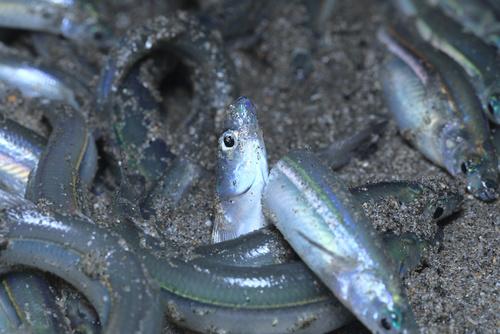
California Grunion
Leuresthes tenuis
Witness the silver tide! The California Grunion is a remarkable fish that leaves the ocean to dance on the sand during midnight spawning runs.
Quick Identification
Size
Grows to approximately 15-19 cm (6-7.5 inches) in length; weighs roughly 50-100 grams.
Colors
Silvery-white underside and sides with a prominent silvery-blue lateral stripe; the back is usually a translucent green or greyish-blue.
Key Features
- Slender, elongated body shape
- Distinct silvery lateral stripe along the side
- No teeth present in the mouth
- Two widely separated dorsal fins
When You’ll See Them
Geographic range
Where Does the California Grunion Live?
Native to the eastern Pacific coastline of North America, the California Grunion is a true regional specialist. Its core range spans from the cool waters of Monterey Bay in Central California down through Southern California and into the warm, arid coastlines of Baja California, Mexico. They are strictly coastal residents, rarely found more than a few miles from the shore, as they rely on specific intertidal sandy environments for their reproductive cycle.
Basemap © OpenStreetMap contributors
Behavior
When not spawning, Grunion are schooling fish that inhabit the nearshore surf zone. They are relatively social and move in large groups to protect themselves from predators. While they are not known for long-range migrations, they do move into slightly deeper waters during the day to avoid visual predators like gulls and then return to the shallows as darkness falls.
Human interaction with Grunion is primarily centered around 'grunion hunting' or observation. In California, these runs attract thousands of spectators. Because they are vulnerable while on the beach, their harvest is strictly regulated by seasonal closures and gear restrictions (only bare hands are allowed) to ensure the population remains stable.
EverydayEarth exclusive
Camera Tips
Capturing the magic of a grunion run requires a camera setup that can handle low-light conditions and salt spray. For beach-side 'backyards,' use a trail camera with high-quality 'No-Glow' infrared LEDs. This ensures you capture the fish's silver reflections without scaring them (or blinding other beach-goers) with a bright white flash. Mount your camera on a short, weighted tripod or a sand-stake about 6-12 inches off the ground to get a dramatic, low-angle perspective of the fish emerging from the waves.
Timing is everything for this species. Set your camera to record 20-30 second video clips during the predicted peak run times, which usually occur 30 to 60 minutes after the high tide on the second, third, and fourth nights following a full or new moon. Use a high-sensitivity (ISO) setting if your camera allows, as the silver bodies of the Grunion will pop beautifully against the dark, wet sand under infrared light.
Protection from the elements is vital. Even if your camera is 'waterproof,' the salt air and occasional rogue wave can be corrosive. We recommend placing your camera inside a clear, salt-resistant housing or wiping the lens and seals with fresh water immediately after your session. Aim the camera toward the 'wash zone' where the waves reach their highest point on the sand, as this is where the highest density of spawning activity occurs.
Frequently Asked Questions
Record California Grunion at your habitat
Connect a camera to start building your own species record — AI identifies every visitor automatically.