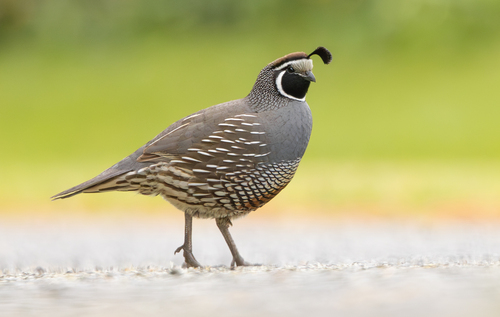
California Quail
Callipepla californica
The iconic state bird of California, this charismatic quail is beloved for its nodding topknot and social 'Chicago' call. A master of the underbrush, it brings life and movement to Western backyards and wild spaces alike.
Quick Identification
Size
9.1–10.6 in (23–27 cm) long; 12.6–14.6 in (32–37 cm) wingspan; 5–8 oz (140–230 g)
Colors
Males feature a black face and throat with white borders, a blue-gray chest, and a scaly-patterned belly; females are a more uniform grayish-brown.
Key Features
- Curving, comma-shaped black topknot plume
- Scaly feather pattern on the lower breast and belly
- Plump, round body with a short tail
When You’ll See Them
Sightings on EverydayEarth
Jun 6, 2026
A group of scavengers is active on a grassy hillside. Several Turkey Vultures and Common Ravens are gathered around a carcass, competing for position and feeding. In the foreground, a small covey of California Quail is seen scurrying through the tall, dry grass, foraging near the larger birds.
Geographic range
Where Does the California Quail Live?
Native to the western edge of North America, the California Quail is a permanent resident from southern British Columbia through the Pacific Coast states down to the tip of the Baja Peninsula. While they are most synonymous with the California landscape, their adaptable nature has allowed them to thrive in parts of Idaho, Nevada, and Utah. Beyond their native range, successful populations have been introduced to distant locations including Hawaii, New Zealand, Chile, and Australia, where they occupy similar scrubland niches.
Basemap © OpenStreetMap contributors
Behavior
California Quail are highly social, gregarious birds that spend most of their time in groups called 'coveys.' During the non-breeding season, these coveys can include dozens of individuals that forage together, moving in a coordinated fashion across the ground. They are primarily ground-dwellers and prefer to run rather than fly when threatened, though they will take to the air with an explosive burst of wingbeats if a predator gets too close.
These birds are famous for their 'Chicago' call—a three-note assembly call that helps covey members stay in contact while moving through dense brush. In the spring, males will find a high perch, such as a fence post or a large rock, to belt out their territorial calls and keep watch over their mate. They are generally tolerant of humans and can become quite bold in suburban backyards where food and cover are provided.
EverydayEarth exclusive
Camera Tips
To capture great footage of California Quail, you need to think low. These are ground-dwelling birds, so mount your camera just 6 to 12 inches off the ground. Aiming the lens slightly upward or level with the ground will give you a 'bird's-eye view' of their intricate scaly belly patterns and famous topknots. Position the camera near 'escape cover'—the dense bushes or brush piles where they feel safe retreating.
Luring quail to your camera is relatively easy with the right bait. Scatter a mix of cracked corn, white proso millet, or high-quality wild bird seed directly on the ground in front of the lens. If you live in a dry climate, a ground-level birdbath or a simple dripping water source is often even more effective than food, especially during the hot summer months. They often visit these spots in large groups, providing excellent multi-subject shots.
Set your camera to take short video clips or high-speed bursts. Quail are twitchy and fast-moving, and you’ll want to capture their unique 'dusting' behavior, where they vigorously flap their wings in dry dirt to clean their feathers. Because they are most active during the 'golden hours' of dawn and dusk, ensure your camera has a good low-light sensor or adjust your exposure settings to prevent grainy footage during these peak activity windows.
Similar Species
Species that look similar or are commonly confused with California Quail.
Frequently Asked Questions
Record California Quail at your habitat
Connect a camera to start building your own species record — AI identifies every visitor automatically.