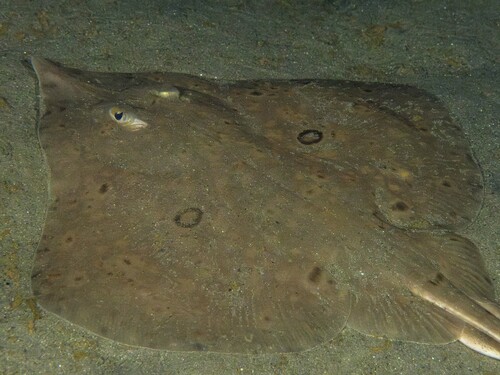
California Skate
Caliraja inornata
A master of seafloor camouflage, the California Skate glides gracefully through Pacific coastal waters, leaving behind mysterious 'mermaid's purses' as a trace of its presence.
Quick Identification
Size
Total length up to 76 cm (30 inches); disk width is typically 60-70% of the total length.
Colors
The upper surface is olive-gray to tan with subtle dark mottling and often two dark 'eyespots' (ocelli) at the base of the pectoral fins; the underside is pale or white.
Key Features
- Distinctly pointed snout with a firm, diamond-shaped body disk
- Two small dorsal fins situated near the tip of the tail
- A series of small, sharp spines or 'thorns' running along the midline of the back and tail
When You’ll See Them
Geographic range
Where Does the California Skate Live?
Native to the Eastern Pacific coast of North America, the California Skate thrives in the cool, nutrient-rich waters of the California Current. Its core range spans from the central coast of California down through the Pacific waters of Baja California, Mexico. While most abundant in these temperate regions, its distribution extends as far north as the Strait of Juan de Fuca near the border of Washington and British Columbia.
Basemap © OpenStreetMap contributors
Behavior
The California Skate is a benthic (bottom-dwelling) species that spends much of its time partially buried in the sand or mud of the seafloor. This behavior serves as both a hunting strategy and a defense mechanism, allowing the skate to blend seamlessly with the sediment while waiting for unsuspecting prey. They move with a graceful, undulating motion of their pectoral fins, a process often described as 'flying' through the water.
Unlike many other marine creatures, California Skates are solitary and relatively sedentary, though they may shift to deeper waters depending on the season or temperature. They are oviparous, meaning they lay eggs. These eggs are encased in tough, leathery protective capsules known as 'mermaid's purses,' which feature long horns at the corners to help them anchor to the seafloor or marine vegetation. Humans most frequently encounter evidence of this species when these empty black egg cases wash up on beaches after the young have hatched.
EverydayEarth exclusive
Camera Tips
Capturing a California Skate on camera requires specialized underwater equipment, as they are rarely seen at the surface. For those with 'ocean backyards' or access to piers and tide pools, use a waterproof action camera or a submersible trail camera designed for marine environments. The best placement is on the seabed in areas with sandy patches adjacent to eelgrass beds, as skates frequent these 'edge' habitats to hunt for crustaceans.
Because skates are bottom-dwellers, mount your camera only a few inches off the substrate, angled slightly downward. Using a weighted 'sand-anchor' mount will prevent the camera from drifting with the current. If you are filming in deeper water or at night, subtle red-light illumination is preferable to bright white light, which can startle marine life or cause excessive backscatter from floating sediment particles.
Patience is key, as California Skates are masters of camouflage. Look for the 'breathing' movement of their spiracles (the holes behind their eyes) or the slight outline of their disk in the sand. Setting your camera to record short video clips (15-30 seconds) rather than still photos is much more effective for identifying the skate's movement as it unburies itself to glide across the floor. In rocky tide pools during very low tides, you may be able to capture them in shallow water; ensure your camera is positioned to minimize surface glare.
Similar Species
Species that look similar or are commonly confused with California Skate.
Frequently Asked Questions
Record California Skate at your habitat
Connect a camera to start building your own species record — AI identifies every visitor automatically.