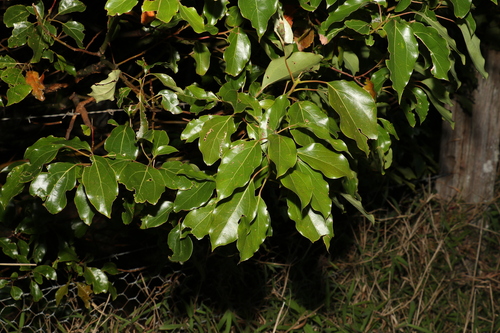
Camphor
Camphora officinarum
A majestic East Asian evergreen famous for its aromatic wood and cooling canopy. This architectural giant is a sanctuary for birds and a hallmark of subtropical landscapes.
Quick Identification
Size
20–30 m (65–100 ft) in height, with a canopy often wider than the tree is tall; trunk diameter 0.6–1.5 m (2–5 ft).
Colors
Glossy bright green leaves, often turning vibrant red before falling; small white-to-yellow flowers; dark purple-to-black berries.
Key Features
- Strong aromatic camphor scent when leaves are crushed
- Glossy evergreen leaves with three distinct veins from the base
- Rough, greyish-brown bark that becomes deeply fissured with age
- Small, pea-sized black fruits produced in large clusters
When You’ll See Them
Geographic range
Where Does the Camphor Live?
The Camphor tree is indigenous to the warm temperate and subtropical regions of East Asia, including southeastern China, Taiwan, southern Japan, Korea, and Vietnam. It has since been widely introduced across the globe for its medicinal and ornamental value, establishing significant naturalized populations in Australia, South Africa, and the southeastern United States, particularly from Texas to Florida. In these introduced ranges, it thrives in humid climates where it often escapes cultivation to colonize local woodlands and disturbed sites.
Basemap © OpenStreetMap contributors
Behavior
The Camphor tree is a long-lived, massive evergreen that plays a significant role in its ecosystem as both a provider of dense shade and a prolific food source. It is known for its allelopathic properties, meaning it releases chemical compounds into the soil that can inhibit the growth of competing plant species nearby. This strategy allows it to dominate forest edges and suburban landscapes alike. While it provides a lush canopy year-round, it is particularly notable for its 'staggered' leaf drop, where older leaves turn a brilliant, fiery red before falling, even while the rest of the tree remains green.
For local wildlife, the tree acts as a vital hub during the fruiting season. In suburban environments, it serves as a major nesting site for various bird species due to its dense, protective foliage. However, in regions where it has been introduced, such as Australia or Florida, its aggressive growth and the high germination rate of its seeds (often spread by birds) can lead it to displace native vegetation, making it a controversial figure in modern land management. Despite this, its resilience and the cooling effect of its massive canopy make it a frequent companion in older suburban neighborhoods.
EverydayEarth exclusive
Camera Tips
Capturing the Camphor tree on camera is less about movement and more about documenting the ecosystem it supports. To capture the best visuals of the tree itself, use a wide-angle lens during the early morning or 'golden hour' to highlight the texture of its deeply fissured bark. If your AI camera is set up for time-lapse, the Camphor tree is an excellent subject during the spring when new, bronze-colored growth emerges, or in the winter when the occasional leaf turns a striking red, providing a beautiful contrast against the glossy green canopy.
For those interested in the 'wildlife' aspect of the tree, focus your camera on the fruit clusters during late autumn and winter. The pea-sized black berries are a magnet for frugivorous birds like Cedar Waxwings, Robins, and various species of Currawongs or Parrots depending on your region. Position your camera on a sturdy branch overlooking a heavy fruiting cluster, using a fast shutter speed to freeze the action of birds landing and feeding. Because the canopy is so dense, you may need to adjust your exposure settings to account for deep shadows, even on sunny days.
Additionally, the massive, rough-textured trunk of an older Camphor tree is a high-traffic area for various insects and the reptiles that hunt them. Mounting a camera at eye level against the trunk can reveal the secret world of bark-creepers, lizards, and even squirrels that use the tree as a highway. If you are in a region where the tree is considered invasive, use your camera to document the seedling density around the base, which can be a fascinating study in plant dispersal and competition.
Similar Species
Species that look similar or are commonly confused with Camphor.
Cinnamon Tree
While related and having similar leaf veins, Cinnamon leaves are typically longer and lack the intense 'Vicks' or menthol scent of crushed Camphor.
Sweetbay Magnolia
Has similar glossy leaves, but the undersides are silvery-white and it lacks the three-veined leaf structure at the base.
Frequently Asked Questions
Record Camphor at your habitat
Connect a camera to start building your own species record — AI identifies every visitor automatically.