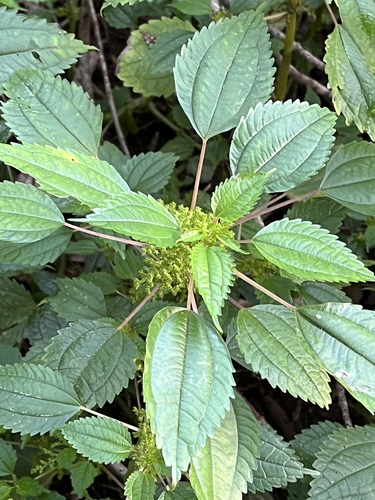
Canada clearweed
Pilea pumila
Meet the translucent wonder of the forest floor. Canada clearweed is a smooth, glass-like member of the nettle family that brings a lush, glowing green to the darkest corners of the shade.
Quick Identification
Size
Stands 4–24 inches (10–60 cm) tall with a spread of 6–12 inches (15–30 cm)
Colors
Translucent light green or watery stems; bright green foliage with a shiny, almost metallic luster
Key Features
- Translucent, watery-looking stems
- Opposite leaves with three prominent curved veins
- Non-stinging hairs (smooth to the touch)
- Inconspicuous greenish flower clusters in the leaf axils
When You’ll See Them
Geographic range
Where Does the Canada clearweed Live?
Canada clearweed is native to North America and East Asia, thriving in temperate climates across both continents. In North America, its core range extends from the Canadian provinces of Ontario and Quebec down through the eastern and central United States to the Gulf Coast. In Asia, it is widely distributed throughout China, Japan, Korea, and parts of the Russian Far East, where it is frequently found in the cool, humid microclimates of mountain valleys.
Basemap © OpenStreetMap contributors
Behavior
Canada clearweed is a shade-loving annual that acts as a lush groundcover in damp environments. Unlike many of its relatives in the nettle family, it lacks the irritating stinging hairs, making it a gentle inhabitant of the forest floor. It typically emerges in late spring and grows rapidly throughout the summer, reaching its peak size just as its tiny, wind-pollinated flowers begin to bloom in late July.
This species is highly sensitive to moisture levels and serves as a natural indicator of soil hydration. During dry spells, the translucent stems may lose their turgidity, but they quickly recover after a soaking rain. It often grows in dense colonies, competing effectively in low-light conditions where other plants might struggle, providing essential cover for small soil-dwelling invertebrates.
EverydayEarth exclusive
Camera Tips
To capture the unique beauty of Canada clearweed, you need to focus on its namesake feature: the translucent stem. Place your camera at a very low profile, approximately 5 to 10 inches from the ground, using a macro lens if available. Positioning the camera so the plant is backlit by the morning or late afternoon sun will cause the stems to 'glow' on film, revealing the watery interior that distinguishes this species from common weeds.
Since Canada clearweed doesn't move, it is the perfect candidate for time-lapse photography. Set your AI camera to trigger at intervals of 30 minutes during a period of high growth, such as the humid days of mid-July. This allows you to witness the 'nyctinasty' or leaf movement as the plant reacts to changing light levels throughout the day. If your camera has a close-focus trigger, place it near a colony to capture the various insects, like the Aphid-feeding flower flies, that frequently visit the foliage.
Because this plant thrives in high-moisture environments, ensure your camera housing is well-sealed against humidity. The best time to photograph clearweed is immediately after a rainstorm when water droplets cling to the serrated leaf edges and the translucent stems are at their most turgid. For the best color saturation, use a circular polarizer to cut the shine off the glossy leaves, which can otherwise cause overexposure in bright, dappled forest light.
Similar Species
Species that look similar or are commonly confused with Canada clearweed.
Frequently Asked Questions
Record Canada clearweed at your habitat
Connect a camera to start building your own species record — AI identifies every visitor automatically.