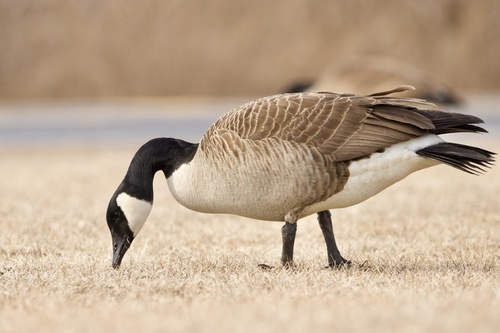
Canada Goose
Branta canadensis
The Canada Goose is the ultimate suburban survivor, recognized globally for its iconic 'V' flight formations and fierce devotion to family. Whether they are migrating through the clouds or grazing in a neighborhood park, these majestic waterbirds are a constant reminder of the wild within our reach.
Quick Identification
Size
Length: 76–110 cm (30–43 in); Wingspan: 127–185 cm (50–73 in); Weight: 3.2–6.5 kg (7–14 lb)
Colors
Signature black head and long neck with a prominent white chinstrap; brown back and wings with a lighter tan or cream breast; white feathers under the tail. Males and females look identical, though males are often slightly larger.
Key Features
- Distinct white cheek patch and chinstrap on a black head
- Long, graceful black neck
- Large, heavy brown body with a pale underside
- Loud, resonant 'honking' call typically heard during flight
When You’ll See Them
Sightings on EverydayEarth
Jul 23, 2026
A group of Canada Geese, including several adults and smaller juveniles, are grazing and resting in a green field near a body of water.
Jun 28, 2026
A group of Canada Geese swims across a quiet pond. Some individuals are seen dabbling for food, tipping their heads below the surface, while others glide across the water. The pond is surrounded by lush summer vegetation and features many lily pads.
Jun 1, 2026
An Osprey is perched in its large stick nest, looking around the expansive green landscape. In the background, a small group of Canada Geese is seen walking through the wet grass near a path.
May 28, 2026
A pair of Canada Geese glides across a tranquil pond, accompanied by several small goslings. The family moves steadily from left to right, leaving gentle ripples on the water's surface under the late afternoon sun.
May 28, 2026
A Horned Lark is perched on a stick-built nesting platform, turning its head to survey the surrounding wetlands. In the background, several Canada Geese are swimming in the river. The scene is illuminated by the morning sun, with light mist clinging to the water's surface.
May 27, 2026
Two Canada Geese swim calmly in the open water near a shoreline of tall reeds. They move slowly across the surface, occasionally turning their heads to scan the environment while swimming in the vicinity of an elevated nesting platform.
Geographic range
Where Does the Canada Goose Live?
Native to the North American continent, the Canada Goose is found in nearly every corner of the United States and Canada, from the Arctic tundra down to the southern borders of the US. While they thrive across their massive native range, they have also established significant introduced populations across the United Kingdom, Scandinavia, and parts of New Zealand and South America. These birds are exceptionally hardy, allowing them to inhabit diverse climates ranging from frozen northern wetlands to temperate suburban neighborhoods.
Basemap © OpenStreetMap contributors
Behavior
Canada Geese are highly social and intelligent birds, famous for their strong family bonds and iconic 'V' formation flight patterns. They are monogamous and typically mate for life, with pairs remaining together year-round. During the breeding season, they become fiercely territorial, with gander (males) often lowering their heads and hissing or charging at anything—including humans—that gets too close to their nesting site.
In suburban environments, they have become incredibly well-adapted, frequently grazing on the short, manicured grass of golf courses, parks, and backyard lawns. While they are powerful fliers capable of migrating thousands of miles, many 'resident' populations in temperate areas have stopped migrating altogether because human-made landscapes provide a steady food supply and safety from predators year-round.
EverydayEarth exclusive
Camera Tips
To capture high-quality footage of Canada Geese, place your camera near the water's edge or in a flat, grassy area where you’ve seen them grazing. Since these are large birds, mount your camera at a height of about 1 to 2 feet (30-60 cm) off the ground and tilt it slightly upward to capture their full height and long necks. If you're near a pond, aim the camera at 'launch' or 'landing' zones where the bank meets the water, as this provides dramatic footage of splashing and wing-stretching.
Because Canada Geese move relatively slowly while grazing but can take off in a sudden flurry of motion, use a camera with a fast trigger speed (under 0.5 seconds) and set it to take short video clips rather than just still photos. Their white cheek patches and pale breasts can easily reflect bright sunlight, so try to position the camera with the sun at its back to avoid 'white-out' highlights on your subjects. Early morning and late afternoon offer the best lighting for their brown and black plumage.
While no special bait is usually necessary if you have a lawn, they are particularly attracted to tender new grass or spilled birdseed. However, be mindful that these birds are heavy and move in groups; a single flock can quickly fill a memory card with 'false' triggers if you have the sensitivity set too high on a windy day. Use 'Hybrid Mode' (photo followed by video) to document both the group count and their social interactions, such as grooming and 'triumph ceremonies' after territorial disputes.
Similar Species
Species that look similar or are commonly confused with Canada Goose.
Frequently Asked Questions
Record Canada Goose at your habitat
Connect a camera to start building your own species record — AI identifies every visitor automatically.