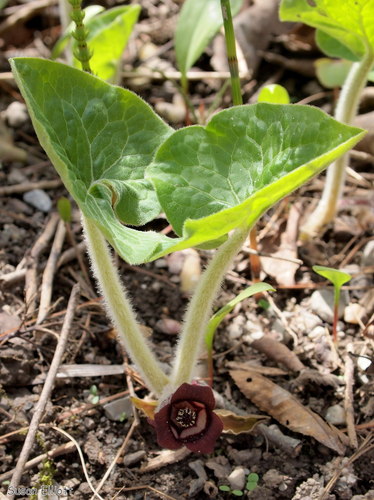
Canadian wild ginger
Wildflowers Active during the day

Canadian wild ginger

Asarum canadense

A secretive treasure of the North American woodland, Canadian wild ginger blankets the forest floor with velvety heart-shaped leaves and hides its strange, maroon blooms right at your feet.

0 Sightings
0 Habitats

Quick Identification

straighten

Size

Height of 10–20 cm (4–8 in); leaves spread 7–15 cm (3–6 in) wide

palette

Colors

Soft, matte-green foliage; flowers are dark maroon, brownish-purple, or madder-red

visibility

Key Features

  • Paired, velvety, heart-shaped leaves
  • Single bell-shaped flower hidden at ground level
  • Hairy stems and leaf undersides
add_a_photo
Is this a Canadian wild ginger?

Drop a photo or video, or paste from clipboard

When You’ll See Them

schedule
Activity pattern Active during the day
brightness_5
Peak hours Daylight hours for photosynthesis
calendar_month
Season April-July
restaurant
Diet Autotrophic plant that produces energy via photosynthesis; prefers nutrient-rich, moist, acidic to neutral soils
park
Habitat Rich deciduous woodlands, shaded riverbanks, and moist, suburban woodland gardens

public Geographic range

Where Does the Canadian wild ginger Live?

North America is the native home of the Canadian wild ginger, where it serves as a staple of the eastern deciduous forests. Its range is expansive, stretching from New Brunswick and southern Quebec in Canada, all the way down to the mountains of Georgia in the United States. It is commonly found as far west as the Great Plains, spanning through Minnesota, Iowa, and eastern Kansas, thriving wherever there is sufficient shade and consistent soil moisture.

Basemap © OpenStreetMap contributors

2 Countries
3.2M km² Range
Least Concern Conservation
US United States CA Canada
eco
iNaturalist / Verified observation data
View on iNaturalist open_in_new

Explore more Wildflowers arrow_forward

Behavior

Canadian wild ginger is a slow-growing, colony-forming perennial that defines the forest floor in early spring. Unlike many wildflowers that reach for the sun, this plant keeps a low profile, with its unique cup-shaped flowers blooming tucked away beneath its large, umbrella-like leaves. It is deciduous, meaning its lush green carpet will die back with the first hard frost, only to emerge from its shallow rhizomes as soon as the soil warms in April.

The plant exhibits a fascinating relationship with the local environment. Because its flowers are located at the soil surface, it doesn't rely on bees or butterflies for pollination. Instead, it attracts ground-crawling insects like beetles and fungus gnats. Furthermore, it engages in a symbiotic relationship with ants; the seeds have a fatty attachment called an elaiosome that ants love. The ants carry the seeds to their nests, eat the snack, and effectively 'plant' the ginger in a new location.

photo_camera EverydayEarth exclusive

Camera Tips

Capturing the Canadian wild ginger requires a different approach than filming mobile wildlife. Because the flower is 'geocarpic'—meaning it blooms at the soil level—you must mount your camera at a worm's-eye view. Use a sturdy ground-stake or a low-profile beanbag mount to get the lens within 3 inches of the forest floor. Angle the camera slightly upward to peek under the heart-shaped leaves where the maroon blossom hides.

Lighting is your biggest challenge in the deep shade where this plant thrives. If you are using a trail camera, look for one with a high-quality 'No-Glow' flash or adjustable exposure settings to prevent the velvety leaves from looking washed out. Natural, dappled sunlight in the early morning (between 8:00 AM and 10:00 AM) provides the best texture-revealing light for the plant's fuzzy stems and leaves.

For those interested in the 'wildlife' aspect of this plant, set your camera to time-lapse mode or a high-sensitivity video trigger during May. You might capture the fascinating sight of ants carrying the seeds away or beetles crawling into the jug-like flowers. Since the plant is stationary, use a macro lens if possible to highlight the fine white hairs that cover the plant, which are designed to deter larger herbivores but look stunning on high-definition displays.

Frequently Asked Questions

As a plant, Canadian wild ginger is most active during daylight hours when it performs photosynthesis. However, its flowers are open 24/7 during their brief blooming window in late spring (April to May), waiting for ground-dwelling pollinators.
You can attract this species by creating a 'woodland' environment in a shady corner of your yard. They require moist, well-drained soil rich in organic matter (like leaf mulch). It is best to purchase nursery-propagated plants rather than harvesting from the wild.
Canadian wild ginger doesn't 'eat' in the traditional sense; it creates its own food from sunlight, water, and carbon dioxide. It does, however, require nutrient-rich soil high in decomposed leaf litter to thrive.
Yes, they are common in older suburban neighborhoods with established tree canopies and can be found in many shaded backyard gardens as an ornamental native groundcover.
The easiest way is to look at the leaves: Canadian wild ginger has matte, velvety, hairy leaves that die back in winter, while European wild ginger (Asarum europaeum) has shiny, dark green, leathery leaves that are evergreen.

Record Canadian wild ginger at your habitat

Connect a camera to start building your own species record — AI identifies every visitor automatically.

Join free Identify a photo