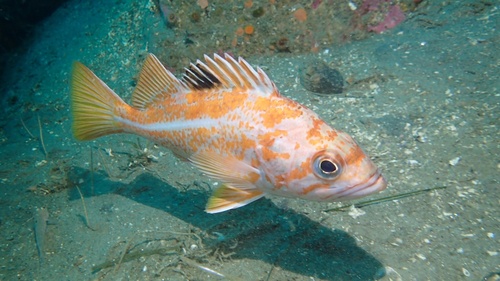
Canary Rockfish
Sebastes pinniger
A vibrant splash of sunset orange in the deep blue Pacific, the Canary Rockfish is a long-lived marvel of the kelp forest. Known for its distinct white lateral line and social nature, it is a favorite for underwater explorers and coastal residents alike.
Quick Identification
Size
Typically 40–50 cm (16–20 inches) in length, but can reach up to 76 cm (30 inches) and weigh over 4.5 kg (10 lbs).
Colors
Bright orange to yellowish-orange body with light gray mottling on the back; a distinct white or light gray lateral line is visible along the side. Fins are usually orange with dark edges in younger individuals.
Key Features
- Bright orange or sunset-colored body
- Clear white or gray lateral line
- Three orange stripes radiating from the eye across the head
- Deeply notched dorsal fin
- Orange-colored eyes (unlike the bright yellow of similar species)
When You’ll See Them
Geographic range
Where Does the Canary Rockfish Live?
Native to the North American Pacific coast, the Canary Rockfish is found from the western Gulf of Alaska down to northern Baja California. They are most densely populated in the temperate waters off the coasts of British Columbia, Washington, Oregon, and Northern California. These fish are a hallmark of the Pacific Northwest's marine ecosystem, thriving in high-relief rocky areas from the shoreline down to the edge of the continental shelf.
Basemap © OpenStreetMap contributors
Behavior
Canary Rockfish are highly social fish that often congregate in large schools, especially when they are younger. They are long-lived creatures, with some individuals reaching ages of over 75 years. They spend most of their time hovering near rocky structures or drifting through kelp forests, using their camouflage to blend in with the golden-brown seaweed and rocky crevices.
While they are generally wary of large predators, they are curious about slow-moving objects. In the wild, they exhibit a relatively sedentary lifestyle once they establish a territory, though they may move to deeper waters as they age. They are opportunistic predators, often hovering motionless before darting forward to swallow prey whole using suction.
EverydayEarth exclusive
Camera Tips
Capturing Canary Rockfish on camera requires moving beyond the backyard and into the 'blue backyard' of the coast. For those living near the ocean, a submerged 'drop camera' or a camera mounted to a dock piling can yield incredible results. Because these fish are attracted to structure, place your camera near rocky outcrops, artificial reefs, or within the swaying canopy of a kelp forest. A steady, weighted tripod is essential to combat underwater currents and keep your footage stable.
Lighting is your biggest challenge underwater. In shallow water (less than 10 meters), natural sunlight is often sufficient during midday, which is also when Canary Rockfish are most active. For deeper deployments, use a diffused white LED light source. Avoid pointing the light directly at the fish to prevent 'backscatter' from sediment; instead, angle the light from the side to highlight the fish's brilliant orange scales and distinct lateral line.
To attract them to your lens, use a scent-based lure rather than loose bait, which can cloud the water. A perforated PVC tube filled with chopped herring or shrimp attached near the camera's field of view will draw them in. Be patient; these fish are long-lived and cautious. Once they realize the camera isn't a threat, they will often hover directly in front of the lens, providing clear shots of their intricate facial markings and orange eyes.
Similar Species
Species that look similar or are commonly confused with Canary Rockfish.
Yelloweye Rockfish
Yelloweye have bright yellow irises and a more raspy, bright red body color, whereas Canarys have orange eyes and a smoother orange-yellow hue.
Vermilion Rockfish
Vermilions are a deeper, darker red and lack the clear, light-colored lateral line found on the Canary Rockfish.
Copper Rockfish
Coppers have a much darker, brownish-copper upper body and a very prominent white patch along the back half of their lateral line.
Frequently Asked Questions
Record Canary Rockfish at your habitat
Connect a camera to start building your own species record — AI identifies every visitor automatically.