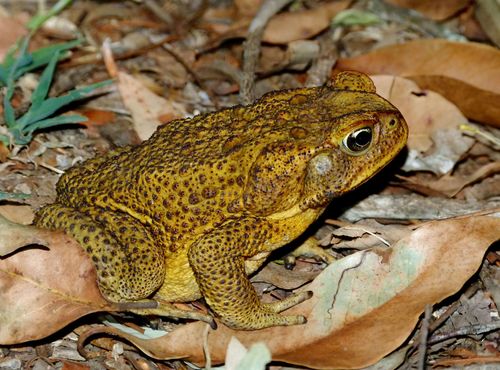
Cane Toad
Rhinella marina
The Cane Toad is a heavyweight of the amphibian world, known for its incredible adaptability and powerful toxic defenses. Whether seen as a garden visitor or an invasive giant, its presence is always unmistakable.
Quick Identification
Size
10–15 cm (4–6 in) on average, reaching up to 24 cm (9.4 in); weight up to 1.3 kg (2.9 lb)
Colors
Shades of grey, yellowish, red-brown, or olive-brown with dark blotches; cream-colored underside with dark mottling
Key Features
- Large, triangular parotoid glands behind the eyes
- Distinctive bony ridges above the eyes that meet at the snout
- Dry, warty, and leathery skin
- Horizontal pupils with golden-brown irises
When You’ll See Them
Geographic range
Where Does the Cane Toad Live?
The Cane Toad is native to the Americas, with a natural range stretching from the Rio Grande Valley in southern Texas through Central America to the Amazon basin in South America. It has gained global notoriety as a highly successful invasive species, having been introduced to numerous islands throughout the Caribbean and Oceania to control agricultural pests. Today, they are most famously established across Northern and Eastern Australia, where they continue to expand their territory rapidly.
Basemap © OpenStreetMap contributors
Behavior
Cane Toads are primarily nocturnal, emerging from their hiding spots at dusk to begin a night of foraging. Unlike many other amphibians that rely solely on movement to detect prey, Cane Toads have a keen sense of smell that allows them to find food even when it is stationary. During the day, they prefer to stay cool and moist, tucking themselves under logs, leaf litter, or man-made structures like porch steps and garden pots.
These toads are famously stoic and rarely flee from predators. Instead, they rely on their potent chemical defense: bufotoxin. When threatened, they secrete a milky-white toxin from the large parotoid glands behind their heads. While they are generally indifferent to human presence, they should never be handled with bare hands, as the toxin can cause severe irritation to the eyes and skin, and is lethal to many domestic pets that might try to bite or lick them.
EverydayEarth exclusive
Camera Tips
To capture high-quality footage of a Cane Toad, the most critical factor is camera height. Because these toads sit low to the ground and have a very flat profile, you should mount your camera just 3 to 5 inches above the soil. Angle the lens slightly upward if the ground is uneven, or keep it level to capture their heavy, deliberate hops. Standard trail camera mounts often sit too high; consider using a specialized ground stake or even a small tripod to get that 'toad's-eye view.'
Cane Toads are highly attracted to areas where insects congregate. A pro-tip for backyard observers is to place the camera near an outdoor light source, such as a porch light or a solar garden lamp. The light draws in moths, beetles, and crickets, creating a natural 'feeding station' that the toads will visit nightly. If you don't have a light source, placing a shallow dish of water in a dry spot can also act as an effective lure, especially during the warmer months when amphibians are seeking moisture.
Because they are ectothermic (cold-blooded), they don't always trigger standard Passive Infrared (PIR) sensors as easily as a warm mammal would. Set your camera's PIR sensitivity to 'High' and use 'Video Mode' or a multi-shot 'Burst Mode.' Since toads often sit perfectly still for long periods while waiting for prey, video is much better at capturing their behavior, such as their unique 'walking' gait or the lightning-fast movement of their tongue when they strike an insect.
Similar Species
Species that look similar or are commonly confused with Cane Toad.
Southern Toad
Much smaller (max 9cm) and has two distinct knobs or 'crests' between the eyes rather than the Cane Toad's flat bony ridges.
American Toad
Features smaller, oval parotoid glands that are either separate from or connected to the eye ridges by a short spur, unlike the Cane Toad's massive triangular glands.
Frequently Asked Questions
Record Cane Toad at your habitat
Connect a camera to start building your own species record — AI identifies every visitor automatically.