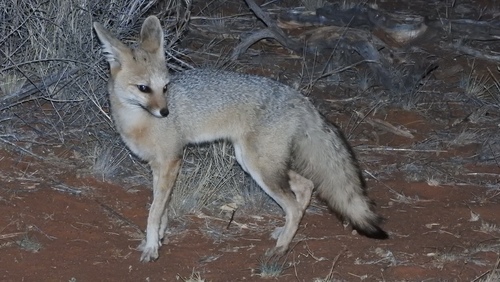
Cape Fox
Vulpes chama
Meet the silver-backed ghost of the African night. The Cape Fox is a petite, elegant predator known for its oversized ears and striking silver fur, making it a favorite for backyard wildlife observers across southern Africa.
Quick Identification
Size
Body length 45–61 cm (18–24 in), tail 30–40 cm (12–16 in); weight 2.5–4.5 kg (5.5–10 lbs)
Colors
Silver-grey mantle on the back, reddish-yellow to tawny limbs and head, with a black-tipped bushy tail and pale underparts
Key Features
- Distinctive silver-grey 'saddle' across the back
- Proportionally large, pointed ears for heat regulation
- Very bushy tail with a prominent black tip
- Slender, delicate build with a pointed muzzle
When You’ll See Them
Geographic range
Where Does the Cape Fox Live?
The Cape Fox is native to the southern tip of the African continent, representing the only 'true fox' species found in sub-Saharan Africa. Its core population resides within South Africa, Namibia, and Botswana, with sightings also common in the high-altitude grasslands of Lesotho and the drier western reaches of Zimbabwe. This hardy canid thrives in the vast open spaces of the Karoo and Kalahari, though it has proven remarkably adept at expanding into human-altered landscapes across the Cape provinces.
Basemap © OpenStreetMap contributors
Behavior
The Cape Fox is a primarily nocturnal and crepuscular hunter, emerging from its burrow as twilight fades to forage under the cover of darkness. While they are essentially solitary foragers, they form monogamous pairs and maintain shared territories, communicating through high-pitched yelps, whines, and chirps that can sound surprisingly bird-like to the untrained ear.
These foxes are incredibly resourceful and spend their daylight hours sheltered from the African sun in underground burrows, which they either excavate themselves or scavenge from larger mammals like aardvarks. In the presence of humans, they are generally shy and non-aggressive, often preferring to vanish into the scrub rather than engage in conflict, though they are increasingly seen on the outskirts of suburban gardens in search of easy meals.
EverydayEarth exclusive
Camera Tips
To successfully capture a Cape Fox on your trail camera, placement is critical. Because they are low-slung animals, mount your camera no higher than 12 to 18 inches (30-45 cm) off the ground. Aiming the lens across a known game trail or toward a clearing near a potential burrow entrance will yield the best results. Since they are strictly nocturnal, a camera with 'No-Glow' infrared technology is essential to avoid startling the fox, which can be quite skittish.
Scent lures can be very effective for bringing a Cape Fox into frame. A small amount of pungent food, such as sardines or a smear of peanut butter on a rock, will often cause them to stop and investigate, giving you a clear, still shot. In arid environments, a low-profile water source or birdbath is an irresistible draw during the dry winter months. Ensure the water is at ground level, as these foxes are unlikely to jump onto high structures for a drink.
Set your camera to a multi-shot burst mode or short video clips (15-20 seconds). Cape Foxes are agile and move with a quick, darting gait; a single photo might only capture a tail or a blurry ear. By using video, you can observe their fascinating social behaviors, such as tail-flagging or scent-marking. Check your camera frequently during the breeding season (August to October) when the pups may be seen following the adults near the den site.
Similar Species
Species that look similar or are commonly confused with Cape Fox.
Frequently Asked Questions
Record Cape Fox at your habitat
Connect a camera to start building your own species record — AI identifies every visitor automatically.