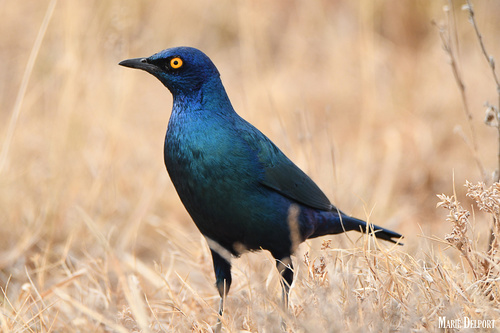
Cape Starling
Lamprotornis nitens
The Cape Starling is a shimmering jewel of the African bushveld and backyard gardens alike. With its brilliant iridescent plumage and inquisitive yellow eyes, it is a favorite for wildlife photographers and backyard observers.
Quick Identification
Size
Length: 23-27 cm (9-11 in); Weight: 75-105g (2.6-3.7 oz)
Colors
Uniformly iridescent blue-green plumage with a metallic sheen; magenta or purple patches on the shoulders; bright yellow-orange eyes.
Key Features
- Brilliant iridescent blue-green plumage
- Striking yellow or orange iris
- Large magenta shoulder patches (often hidden)
- Sturdy black bill and legs
When You’ll See Them
Sightings on EverydayEarth
Jul 17, 2026
In the foreground, a Cape Starling walks across the dry, sandy ground with a purposeful gait. In the background, several Impalas are gathered at the edge of the watering hole, drinking and remaining alert to their surroundings.
Jun 20, 2026
A Cape Starling is seen foraging and hopping along the edge of a waterhole. The bird's bright iridescent feathers stand out against the dry grass and red soil. It periodically pauses to look around before moving further into the foreground.
May 29, 2026
A Cape Starling is actively foraging along the right bank of the watering hole, hopping across the muddy ground and pausing to look around before moving further into the vegetation.
May 19, 2026
Two Cape Starlings forage along the muddy banks of a watering hole under a heavy, overcast sky. One bird walks from the left across the foreground, while a second individual explores the right edge of the water.
Apr 19, 2026
A Cape Glossy Starling is foraging in the grass near the edge of a watering hole during the early morning hours. It hops along the muddy bank, occasionally pausing to look around before moving closer to the water's edge.
Geographic range
Where Does the Cape Starling Live?
The Cape Starling is native to the southern portion of the African continent. It is widely distributed across South Africa, Namibia, Botswana, and Zimbabwe, with its range extending into southern Mozambique, Lesotho, Eswatini, and parts of southern Angola and Zambia. This species is highly adaptable and thrives in both protected wilderness areas and bustling metropolitan suburbs.
Basemap © OpenStreetMap contributors
Behavior
Cape Starlings are highly social and intelligent birds, often seen in small flocks or large communal roosts. They are known for their bold personality, frequently approaching human dwellings, picnic sites, and campsites in search of scraps. Their vocalizations are complex, consisting of a mix of liquid trills, harsh squawks, and impressive mimicry of other birds and even mechanical sounds like car alarms.
In the wild, they often follow large mammals like buffalo or cattle to catch insects stirred up by their movement, and they are sometimes seen perched on these animals to pick off parasites. In suburban environments, they have adapted perfectly to garden life, becoming a staple sight on lawns where they hop with a characteristic upright posture. They are active, busy birds that spend much of their day alternating between ground foraging and social chatter in the canopy.
EverydayEarth exclusive
Camera Tips
To capture the stunning metallic sheen of the Cape Starling, camera placement is everything. Since these birds spend a significant portion of their time foraging for insects on the ground, mounting your camera about 12 to 18 inches off the ground on a sturdy stake or tree trunk is ideal. Aim the camera toward a flat, open patch of lawn or a known dust-bathing spot. Because their feathers are highly reflective, try to position the camera with the sun at its back to avoid 'washing out' the iridescence in your shots; early morning or late afternoon light produces the best color depth.
Water is the ultimate lure for Cape Starlings. They are frequent bathers and will visit bird baths multiple times a day to preen and splash. Set your camera on a 'Burst' or 'Rapid Fire' mode near a water feature; the action of them splashing can create spectacular, high-energy photos. If you are using a bait, suet balls, halved oranges, or even mealworms are highly effective. Place the bait on a low platform or directly on a clean patch of ground within the camera’s focal range.
In terms of settings, a fast trigger speed (0.3 seconds or less) is crucial as starlings are jittery and move with quick, sudden hops. Since they are strictly diurnal, you can save battery life by setting the camera to be active only during daylight hours. During the breeding season (October to March), you might capture interesting social behaviors, including pair bonding and the feeding of fledglings. Ensure your SD card has plenty of space for high-resolution video, as their vocalizations and mimicry are just as fascinating as their appearance.
Similar Species
Species that look similar or are commonly confused with Cape Starling.
Frequently Asked Questions
Record Cape Starling at your habitat
Connect a camera to start building your own species record — AI identifies every visitor automatically.