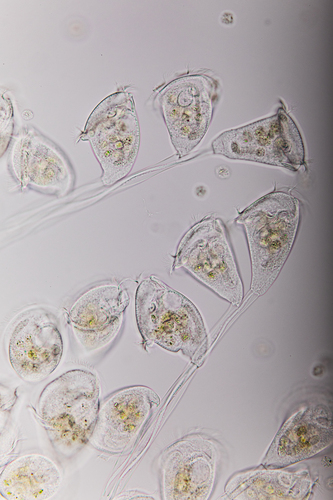
Carchesium
Carchesium polypinum
The microscopic 'glass trees' of your pond. Carchesium polypinum is a colonial wonder that turns a single drop of water into a thriving, branching forest of life.
Quick Identification
Size
Colonies 1–5 mm (0.04–0.2 in) in height; individual cells 50–125 μm in length
Colors
Translucent, milky white, or pale yellow; often appears as a fuzzy white growth
Key Features
- Branched, tree-like colonial structure
- Bell-shaped individual bodies (zooids)
- Independently contractile stalks
- Ciliated 'mouth' at the top of each bell
When You’ll See Them
Geographic range
Where Does the Carchesium Live?
Native to freshwater ecosystems across the globe, Carchesium polypinum is a truly cosmopolitan species found on nearly every continent. It thrives in diverse aquatic environments from the temperate ponds of North America and Europe to the tropical wetlands of Southeast Asia and South America. Because it easily hitches rides on migrating waterfowl or moves through interconnected waterways, it is a common resident in almost any permanent body of freshwater with a healthy bacterial population.
Basemap © OpenStreetMap contributors
Behavior
Carchesium polypinum is a fascinating colonial ciliate that lives a sessile life, attached to submerged surfaces in freshwater environments. Unlike its solitary relative Vorticella, Carchesium forms elaborate, branched colonies that resemble microscopic glass trees. Each individual 'bell' or zooid in the colony functions independently; because their internal contractile fibers (myonemes) are not interconnected, one individual can snap back toward the stalk without disturbing its neighbors—a key behavioral trait that distinguishes them from similar colonial protozoa.
These organisms are master filter-feeders. They use a ring of beating cilia around their oral disc to create a miniature whirlpool, drawing in bacteria and organic particles. While they are essentially microscopic, they are highly sensitive to their environment and will rapidly contract their stalks into a tight coil if they sense mechanical vibrations or the presence of a predator. In a backyard pond, they serve as vital bioindicators, as their presence and abundance often reflect the nutrient levels and bacterial health of the water.
EverydayEarth exclusive
Camera Tips
Capturing the intricate beauty of Carchesium polypinum requires a specialized approach, as these organisms are at the limit of visibility for the naked eye. To document them in your backyard pond, you will need a waterproof digital microscope or a camera equipped with a high-magnification macro lens (at least 2:1 or 5:1 magnification). Look for 'white fuzz' on the undersides of lily pads, submerged twigs, or the shells of pond snails. This is often a thriving colony waiting to be photographed.
Lighting is the most critical factor for success. Because these ciliates are translucent, standard top-down lighting will often make them disappear. Instead, use 'side-lighting' or 'back-lighting' to create a darkfield effect. This illuminates the delicate internal structures and the branching stalks, making them glow against the dark water. Use a steady tripod or a weighted underwater mount, as even the slightest ripple will cause motion blur at these magnification levels.
To capture their unique behavior, set your camera to a high-speed video mode (at least 60fps, though 120fps is better). This allows you to record the lightning-fast contraction of the stalks when the colony is disturbed. If you are using an AI-powered camera system, look for a setup that supports time-lapse photography; recording a colony over 24 hours can reveal how they grow, divide, and interact with the surrounding micro-fauna like rotifers and water fleas.
Similar Species
Species that look similar or are commonly confused with Carchesium.
Frequently Asked Questions
Record Carchesium at your habitat
Connect a camera to start building your own species record — AI identifies every visitor automatically.