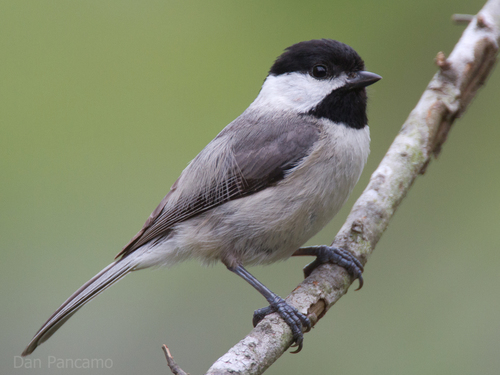
Carolina Chickadee
Poecile carolinensis
A tiny bird with a big personality, the Carolina Chickadee is the acrobatic soul of the Southern backyard. Known for its iconic black cap and cheerful call, this intelligent songbird is a favorite for birdwatchers and camera enthusiasts alike.
Quick Identification
Size
Length: 10–12 cm (3.9–4.7 in); Wingspan: 15–20 cm (5.9–7.9 in); Weight: 8–12 g (0.28–0.42 oz)
Colors
Solid black cap and throat (bib); crisp white cheeks; gray back, wings, and tail; pale underparts with buffy-tan flanks. Sexes look identical.
Key Features
- Distinctive black cap and bib contrasting with bright white cheeks
- Small, acrobatic body with a relatively short tail
- Pale gray wings without bold white edges
- Four-note whistle (fee-bee-fee-bay) unlike the two-note song of northern relatives
When You’ll See Them
Geographic range
Where Does the Carolina Chickadee Live?
Native to the North American continent, the Carolina Chickadee is a quintessential resident of the southeastern United States. Its territory extends from the Mid-Atlantic coast near New Jersey down through Florida and stretches westward across the Gulf States into central Texas and Kansas. While it shares some overlap with its northern relative, the Black-capped Chickadee, the Carolina remains the dominant year-round chickadee of the American South.
Basemap © OpenStreetMap contributors
Behavior
Carolina Chickadees are the high-energy acrobats of the backyard, often seen hanging upside down from twigs or feeders to reach seeds. They are highly social and intelligent, frequently forming the core of mixed-species foraging flocks during the winter. You will often see them traveling with titmice, nuthatches, and woodpeckers, acting as the 'sentinels' of the group by sounding sharp alarms if a predator is spotted.
These birds are famous for their spatial memory. During the autumn, they spend hours caching seeds in thousands of different hiding spots, such as under tree bark or in fence posts. Research shows that their brain actually increases in volume during the winter to help them remember these locations. In suburban environments, they are remarkably bold and curious, often being the first birds to investigate a new feeder or camera setup.
EverydayEarth exclusive
Camera Tips
To capture the best footage of a Carolina Chickadee, place your AI-powered camera within 3 to 5 feet of a bird feeder or a birdbath. Because these birds are extremely fast and move with jerky, sudden motions, set your camera to its highest possible frame rate or use a fast shutter speed setting to avoid motion blur. Position the camera at 'bird-eye level'—roughly 5 to 6 feet off the ground—to get intimate portraits rather than looking down on them from above.
Baiting is highly effective for this species. Black oil sunflower seeds are their absolute favorite, but they are also drawn to suet cages and peanut hearts. Because they tend to 'grab and go'—picking up a single seed and flying to a nearby branch to crack it open—consider placing your camera near a favorite 'landing' branch about 3 feet away from the feeder. This is where they will pause for several seconds to scan for danger, providing your best opportunity for a clear, still shot.
Carolina Chickadees are very early risers and are often the first birds at the feeder at dawn. The soft, directional light of the first two hours of the morning provides the best natural lighting for your captures. If you are using a trail camera in a more wooded area, look for dead snags with small natural cavities. These birds are cavity nesters and will frequently investigate these holes during the spring breeding season (March–May), which can lead to excellent behavioral footage.
During the winter, suet is the primary draw, but in the hot summer months, a shallow birdbath with moving water is a magnet. Adding a solar-powered dripper or bubbler to your water source will attract their attention from a distance. Ensure your camera lens is clean and the focus is sharp, as the intricate detail of their facial feathers and 'bib' is what makes high-resolution captures of this species so rewarding.
Similar Species
Species that look similar or are commonly confused with Carolina Chickadee.
Frequently Asked Questions
Record Carolina Chickadee at your habitat
Connect a camera to start building your own species record — AI identifies every visitor automatically.