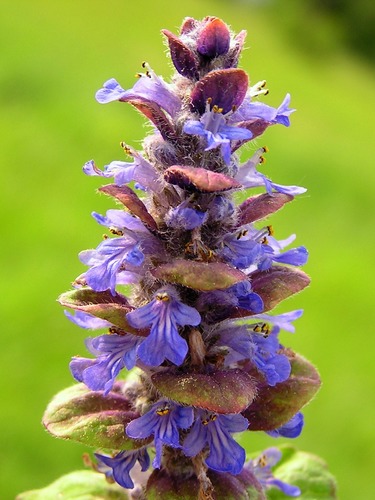
carpet bugle
Ajuga reptans
A lush, spreading groundcover that paints the forest floor in shades of deep blue and bronze. Carpet bugle is a pollinator's paradise and a resilient survivor in the shadiest corners of your backyard.
Quick Identification
Size
Height: 10–20 cm (4–8 inches) during bloom; spreads horizontally 30–60 cm (12–24 inches) per year.
Colors
Deep glossy green to bronze-purple foliage; vibrant violet-blue flowers arranged in whorled spikes.
Key Features
- Upright flower spikes of intense blue or violet
- Glossy, oval leaves that form a dense mat
- Spreads via stolons (horizontal runners) that root at nodes
- Square stems characteristic of the mint family
When You’ll See Them
Geographic range
Where Does the carpet bugle Live?
Native to Europe, North Africa, and Southwest Asia, the carpet bugle is a resilient traveler that has successfully naturalized across much of North America and parts of Oceania. It is most frequently found in the temperate regions of the United Kingdom and Central Europe, where it thrives in the dappled light of deciduous forests. In the United States and Canada, it is a common sight in suburban landscapes, often seen creeping out from under ornamental hedges and into shaded parklands.
Basemap © OpenStreetMap contributors
Behavior
In the wild, it plays a vital role in forest floor ecosystems by stabilizing soil and preventing erosion. It is highly attractive to a wide variety of pollinators, particularly long-tongued bees who can reach the nectar tucked inside its tubular flowers. In suburban settings, it is valued for its ability to grow in deep shade where lawn grasses often fail, though its aggressive spreading nature means it can occasionally escape garden boundaries if not managed.
EverydayEarth exclusive
Camera Tips
To capture the best images of carpet bugle, focus your AI camera on a dense patch during its flowering peak in mid-spring. Because this plant is a low-growing groundcover, you should position your camera at a very low angle—ideally just 4 to 8 inches off the ground. This 'worm's-eye view' highlights the vertical structure of the flower spikes against the dark, glossy leaves, creating a more dramatic and professional-looking shot than a top-down view.
Carpet bugle is a magnet for backyard wildlife, particularly pollinators. Set your camera's trigger to its highest sensitivity and aim it at the most vibrant blue spikes. This is a prime location to capture high-quality footage of bumblebees, honeybees, and various butterfly species. Since these insects move quickly, a fast shutter speed or a high-frame-rate video setting is essential to prevent motion blur during their nectar-feeding visits.
Lighting is critical for this species because its dark foliage can easily 'disappear' into shadows. Early morning or late afternoon 'golden hour' light provides a soft glow that makes the deep blues and purples of the flowers pop. If your camera is placed in a very shady area, try to position it so that a stray beam of sunlight hits the flowers during the day, which will trigger the AI to recognize the vibrant colors more effectively. In winter, the leaves often turn a striking bronze-purple, providing a great opportunity for time-lapse photography to document the plant's seasonal color shifts.
Similar Species
Species that look similar or are commonly confused with carpet bugle.
Frequently Asked Questions
Record carpet bugle at your habitat
Connect a camera to start building your own species record — AI identifies every visitor automatically.