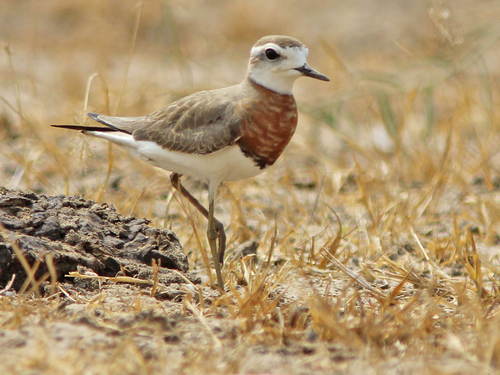
Caspian Plover
Anarhynchus asiaticus
A slender and elegant traveler of the arid steppes, the Caspian Plover is a master of the dry interior. Witness the striking chestnut plumage of this migratory marvel as it journeys from Central Asia to the heart of Africa.
Quick Identification
Size
Length: 18–20 cm (7–8 in); Wingspan: 55–61 cm (22–24 in); Weight: 60–90 g (2.1–3.2 oz)
Colors
Breeding males feature a white face and throat, a broad chestnut breast band with a black lower border, and grey-brown upperparts. Females and non-breeding adults are more muted with a brownish breast band.
Key Features
- Broad chestnut breast band with a thin black lower border in males
- White forehead and prominent supercilium
- Relatively long, greenish-grey legs
- Slender, straight black bill
When You’ll See Them
Geographic range
Where Does the Caspian Plover Live?
The Caspian Plover is a true globetrotter, originating from the vast steppe regions of Central Asia. Its core breeding range centers around the Caspian Sea, extending through Kazakhstan and western China. When the northern winter approaches, these birds undertake an epic migration southward, primarily settling in the grasslands of Eastern and Southern Africa, including countries like Kenya, Tanzania, and South Africa.
Basemap © OpenStreetMap contributors
Behavior
The Caspian Plover is a charismatic long-distance traveler known for its elegant, slender profile and social nature. Unlike many shorebirds that stick strictly to coastlines, this species is a specialist of the dry interior, often found in arid grasslands and salt pans. They are highly gregarious birds, frequently seen in small to medium-sized flocks, especially during their wintering stay in Africa. Their movement is characteristic of the plover family—a series of rapid, staccato runs followed by a sudden tilt to snatch prey from the ground.
While generally wary of humans, they can be surprisingly approachable in remote habitats where they haven't been disturbed. During the breeding season, males perform spectacular aerial displays to attract mates, though most enthusiasts will encounter them on their wintering grounds. Their social structure is loose but cooperative; flock members often alert one another to approaching predators like harriers or falcons using sharp, whistling calls.
EverydayEarth exclusive
Camera Tips
Capturing the Caspian Plover on a trail camera requires targeting their specific preference for wide-open, flat terrain. Because they prefer areas with very short vegetation, place your camera just a few inches off the ground (about 10-15 cm) to get an intimate eye-level perspective. A wide-angle lens is beneficial here, as these birds move quickly and can easily zip out of a narrow frame. Orient your camera to face north or south to avoid the harsh glare of the sun across the open plains, which can wash out the subtle chestnut tones of the plumage.
One of the most effective "baits" for a Caspian Plover isn't food, but water or recently disturbed earth. In dry African wintering grounds, a small, shallow tray of water flush with the soil surface can be an irresistible draw for a flock. Alternatively, these birds are highly attracted to recently burnt grasslands (veld) where insects are exposed. If you can safely position a camera near a patch of burnt grass or a natural salt pan, your chances of a high-quality capture increase significantly.
Set your camera to a fast trigger speed and high-frame-rate burst mode. Plovers are known for their "run-and-pause" foraging style; a single photo might catch them in a blur, but a 3-5 shot burst will likely freeze them during that perfect, statuesque pause. Since they are most active during the cooler parts of the morning and late afternoon, ensure your PIR (passive infrared) sensor sensitivity is set to 'High' to detect their relatively small body heat signatures against the warming ground.
Similar Species
Species that look similar or are commonly confused with Caspian Plover.
Frequently Asked Questions
Record Caspian Plover at your habitat
Connect a camera to start building your own species record — AI identifies every visitor automatically.