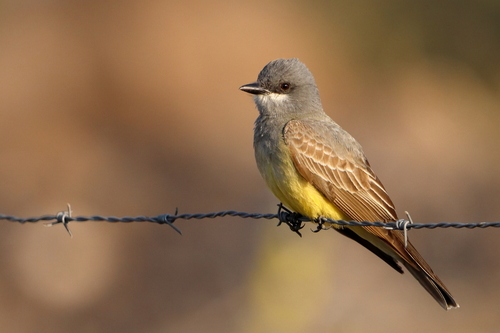
Cassin's Kingbird
Tyrannus vociferans
A bold and vocal sentinel of the West, the Cassin's Kingbird is a master of aerial acrobatics. Watch as this golden-bellied flycatcher defends its territory and hunts insects from the highest perches in the neighborhood.
Quick Identification
Size
Length: 20-23 cm (7.9-9.1 in); Wingspan: 36-41 cm (14-16 in); Weight: 45-56 g (1.6-2 oz)
Colors
Dark olive-gray upperparts, deep gray breast contrasting with a white throat, and a bright yellow belly. The tail is blackish and squared at the tip.
Key Features
- Bright yellow belly contrasting with a clean white throat patch
- Deep gray breast and head
- Dark, squared tail without white outer feathers
- Loud, rhythmic 'chi-beer' vocalization
When You’ll See Them
Geographic range
Where Does the Cassin's Kingbird Live?
The Cassin's Kingbird is a signature species of Western North America and the highlands of Mexico. Its native range extends from the southwestern United States—primarily through California, Arizona, New Mexico, and Texas—down through the heart of Mexico to Guatemala and Honduras. While many populations in the northern reaches are migratory, moving south for the winter, some residents remain year-round in the milder climates of Southern California and central Mexico.
Basemap © OpenStreetMap contributors
Behavior
Cassin's Kingbirds are assertive, high-profile flycatchers known for their commanding presence in open landscapes. They are highly territorial, frequently seen perched on the highest available branches, utility lines, or fences, from which they launch aerial sallies to snatch insects. They are famously aggressive towards larger birds, fearlessly chasing away hawks, crows, and ravens that venture too close to their nesting sites.
Socially, these birds are most active during the breeding season when they perform a dramatic 'dawn chorus.' Before the sun fully rises, males deliver a series of loud, rhythmic calls to establish their territory. While they are not social in the way flocking birds are, they are often found in pairs and are well-adapted to human-altered environments like ranchlands and suburban parks, provided there are tall trees for nesting and perching.
EverydayEarth exclusive
Camera Tips
To capture the Cassin's Kingbird on a backyard camera, focus on their 'vantage point' behavior. These birds rarely spend time on the ground, so avoid placing your camera near low-lying feeders. Instead, mount your camera at a slight upward angle facing the highest exposed branches of a tree or the top of a fence line. They are creatures of habit and will often return to the exact same 'launching' perch dozens of times a day to hunt.
While they won't visit seed feeders, kingbirds are highly attracted to water, especially in arid western climates. A birdbath with a solar-powered fountain or a 'dripper' is the best way to bring them down to a camera's eye level. Position your camera about 4 feet away from the water source, ensuring the focus is sharp on the area where the bird would land to drink or bathe. The sound of moving water is a powerful lure for this species.
Because kingbirds are fast flyers, use a camera with a high trigger speed and set it to record video clips of at least 10-15 seconds. This allows you to capture their characteristic tail-flicking and vocalizations, which are key for identification. The best lighting occurs in the early morning; these birds are among the first to wake up and start moving, so ensure your camera is active and well-charged for the dawn hours.
Similar Species
Species that look similar or are commonly confused with Cassin's Kingbird.
Western Kingbird
Westerns have distinct white outer tail feathers and a paler gray breast compared to the Cassin's.
Tropical Kingbird
Tropicals have a much larger bill and a notched tail, lacking the white throat contrast of the Cassin's.
Couch's Kingbird
Very similar in color but has a notched tail and a much more complex, trilling call.
Frequently Asked Questions
Record Cassin's Kingbird at your habitat
Connect a camera to start building your own species record — AI identifies every visitor automatically.