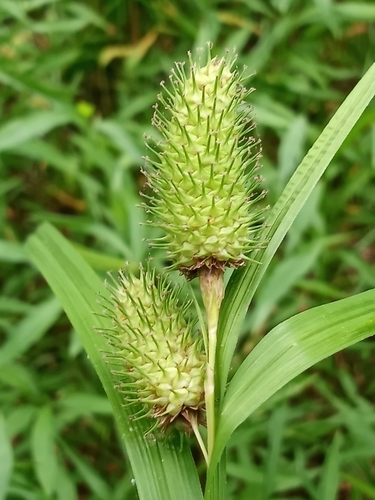
cattail sedge
Carex typhina
A hidden gem of the wetlands, the cattail sedge stands out with its unique, club-like spikes and lush green tufts. This resilient plant is a cornerstone of floodplain ecosystems, offering a glimpse into the intricate beauty of North American swamp flora.
Quick Identification
Size
Height ranges from 30 to 90 cm (12 to 36 inches) with leaves 5 to 10 mm (0.2 to 0.4 inches) wide.
Colors
Lush emerald green foliage; flower spikes transition from pale lime green to a warm straw-brown as they mature.
Key Features
- Dense, cylindrical flower spikes resembling tiny cattails
- Widely-spaced, M-shaped leaf blades
- Smooth, three-sided (trigonous) stems
- Spikes are usually blunt or rounded at the top
When You’ll See Them
Geographic range
Where Does the cattail sedge Live?
The cattail sedge is a native treasure of North America, primarily found across the eastern and central regions. Its range extends from southern Ontario and Quebec in Canada down through the United States to the Gulf Coast, with its highest concentrations found in the Mississippi and Ohio River valleys. It is a specialist of the interior lowlands, rarely venturing into high-elevation mountain ranges.
Basemap © OpenStreetMap contributors
Behavior
During the summer months, it becomes a miniature skyscraper for local biodiversity. It doesn't move in the traditional sense, but its heavy seed heads sway rhythmically in the wind to facilitate pollination. In the late fall, the plant enters a dormant state, with its foliage turning brown and collapsing to provide a protective mulch layer for its own rhizomes and for overwintering invertebrates.
EverydayEarth exclusive
Camera Tips
Since plants do not trigger standard PIR motion sensors, use the 'Time Lapse' feature on your AI camera. Setting an interval of one photo every 30 to 60 minutes during daylight hours will allow you to create a stunning visual record of the plant's growth and the maturation of its seeds over the season. If you are looking for wildlife interaction, high-sensitivity motion settings can sometimes be triggered by the plant swaying in a stiff breeze, often catching the insects or small amphibians that call the sedge home.
Lighting is crucial for this species; the best shots are often captured during the 'golden hours' of early morning or late afternoon when the low sun illuminates the translucent edges of the leaves and seed spikes. Avoid using a heavy flash at night, as it can wash out the delicate green hues. Instead, rely on natural light to showcase the architectural beauty of the foliage. If your camera allows for macro-focusing, try to position it within 2 feet of a flower spike to capture the detailed scales of the perigynia.
Similar Species
Species that look similar or are commonly confused with cattail sedge.
Squarrose Sedge
Very similar in appearance, but its seed spikes are usually more globe-shaped and have a more pointed tip compared to the blunt top of the cattail sedge.
Frank's Sedge
Features much narrower, bristly spikes that are more numerous per stem than the thick, solitary-looking spikes of the cattail sedge.
Frequently Asked Questions
Record cattail sedge at your habitat
Connect a camera to start building your own species record — AI identifies every visitor automatically.